Since 2026 · Guangzhou / Chongqing / Lanzhou · Ultra-Premium
White Cloud Express 南方列车·白云号
China's first Chinese-scholarly-aesthetic luxury train. Ninety-two guests, suites up to 13.7 m2, 18-day panoramas from the Pearl River Delta to the Pamir Plateau. A moving Lingnan courtyard on rails, serving Cantonese-Hunan fusion cuisine and cultural lectures across 8,000 kilometres. From RMB 98,880.
Also published in English as Baiyun Express. The Chinese name 南方列车·白云号 reads Southern Train, Baiyun, after the operator's house brand and Guangzhou Baiyun Station. One train, one set of departures, two English spellings.
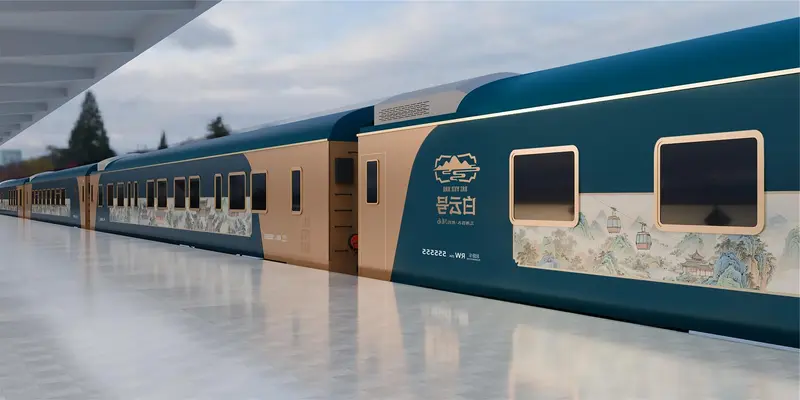
The White Cloud Express represents a new chapter in Chinese luxury rail: the first train conceived from the ground up around a literary, scholarly identity. Announced at Guangzhou Baiyun Station on 25 August 2026, the project is led by Guangzhou Baiyun Investment Group with Hunan Culture, Sports and Tourism Industry Group as a cultural-tourism partner. Sichuan Xinyiyuan International Travel Service supports promotion and market operations only; the train is operated by Guangzhou Southern Train International Travel Service on the China Railway Guangzhou network. The train draws on the deep cultural heritage of Lingnan (Cantonese) and Huxiang (Hunanese) traditions. Every carriage is a themed chapter: a four-door ceremonial entrance hall, a 48-seat dougong-bracket dining room set with Liling gilt porcelain, and a panoramic observation carriage modelled on a classical Chinese garden pavilion. The route spans 18 days, covering the full arc from subtropical Guangzhou to the high-altitude Pamir Plateau.
Several organisations support the White Cloud Express in clearly separated roles. The distinction matters when you book: the project lead, cultural-tourism partner, market promoter, journey operator and railway network are not interchangeable.
Operated by
Guangzhou Southern Train International Travel Service
广州南方列车国际旅行社. Runs the train end to end: itinerary planning, onboard service and guest experience.
Led by
Guangzhou Baiyun Investment Group
广州白云产业投资集团. Initiated and coordinates the project, and holds the Baiyun brand on behalf of Guangzhou's Baiyun district.
Cultural-tourism partner
Hunan Culture, Sports & Tourism Industry Group
湖南文体旅产业集团. Supports the cultural programme and tourism product.
Promotion and market operations
Sichuan Xinyiyuan International Travel Service
四川心已远国际旅行社. Supports promotion and market operations; it is not the train operator.
Runs on the network of
China Railway Guangzhou Group
广铁集团. Provides network capacity, hub operations at Guangzhou Baiyun Station and the transport guarantee.
Who actually rides these trains. In its first year of operation the Panda Express Chengdu (成都号) ran 24 departures carrying 2,466 guests, and 82% of them were international travellers, from Hong Kong, Macau, Taiwan, Southeast Asia, the United States and Canada. The White Cloud Express was announced with the same outward aim: Baiyun district describes it as a way to grow inbound tourism into the Greater Bay Area, which is why English-speaking service here is the default rather than an accommodation.
A Moving Chinese Scholarly Residence
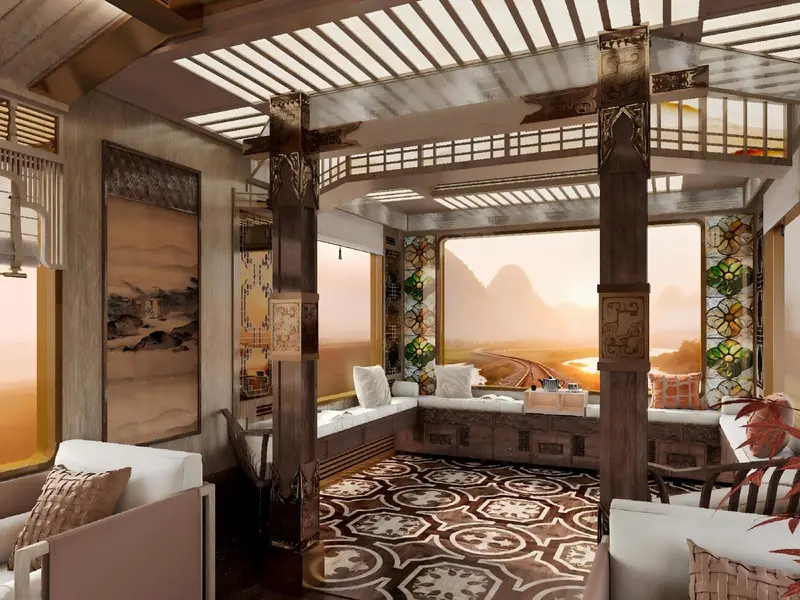
The brief the operator set for these interiors is 造极中韵,东方风雅, "refining the Chinese note, an Eastern grace". Two Cantonese building traditions carry it through the train. The first is the lattice flower window of Lingnan, which crops the passing landscape into a framed picture and is used throughout the carriages. The second is the Cantonese arcade, or 骑楼 (qilou), the colonnaded shopfront whose deep covered walkway lets a street stay busy in the rain. Both are ways of sheltering a walk, and both turn out to translate cleanly to a corridor on wheels.
The four-fold order of a scholar's academy
四重礼序 · borrowed from Yuelu Academy in Changsha
The project is Hunanese as much as Cantonese. The operators describe a thousand years of Huxiang culture at the centre, with the grace of Guangzhou layered over it, and they gave the four public carriages a single sequence taken from the ceremonial order of a traditional academy:
云聚 Yunju, the entrance hall: "opening the vermilion gate of a thousand-year-old Confucian house".
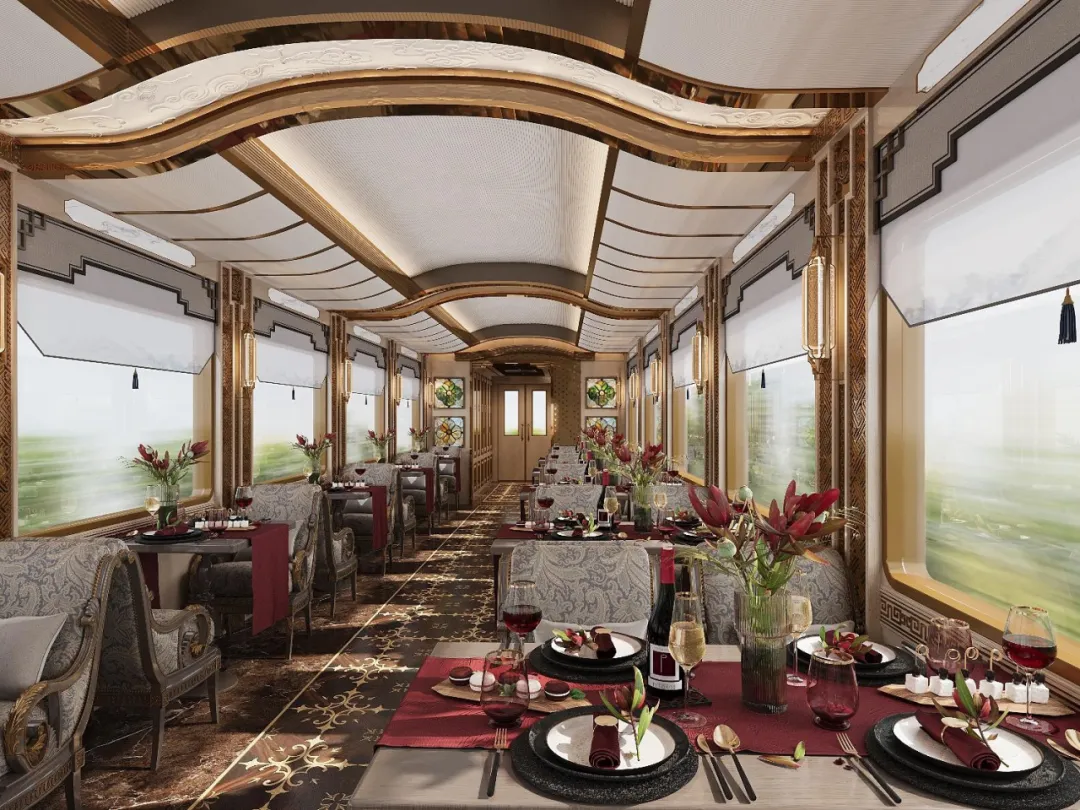
云宴 Yunyan, the dining car: "the ritual order of a scholar's household, kept in a single bowl and a single vessel".
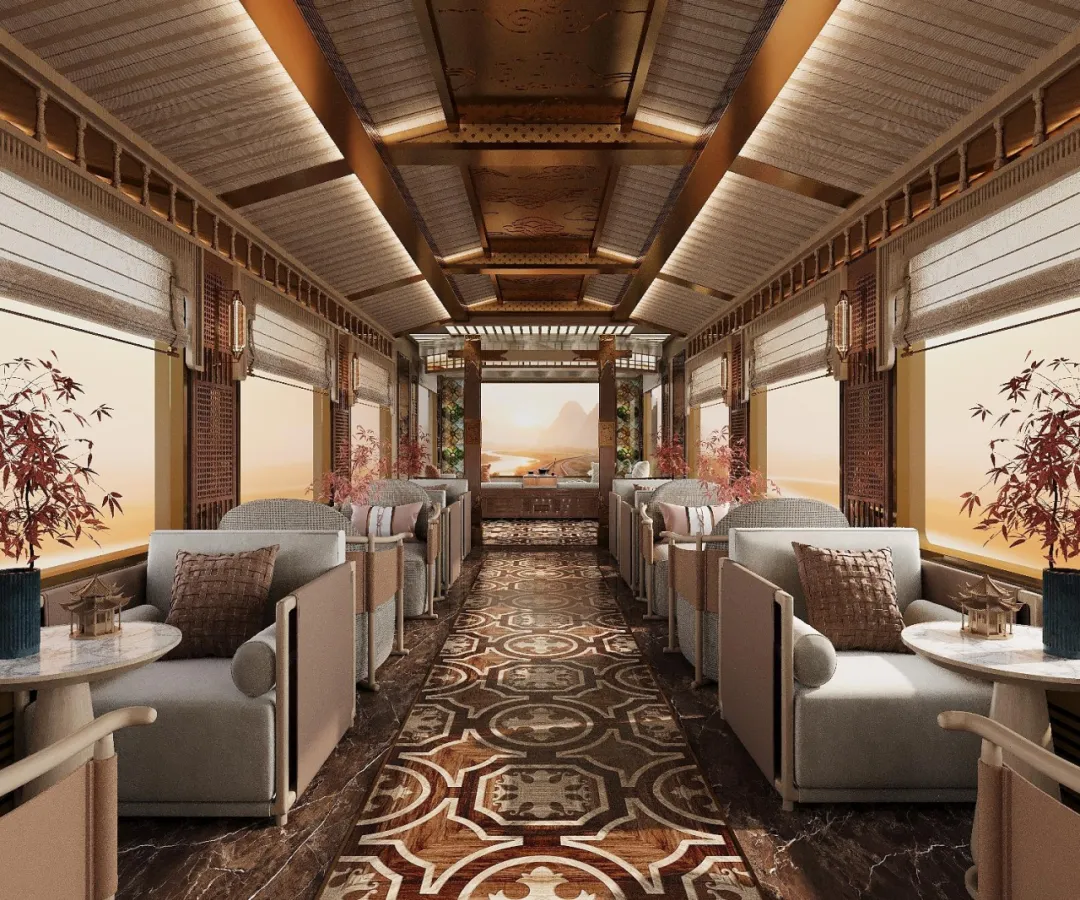
云赏 Yunshang, the observation car: a garden walk in the manner of the Aiwan Pavilion on Yuelu Mountain.
云栖 Yunqi, the sleeping cars: 卧游, the old literati habit of travelling a landscape while lying down.
The rest follows the same logic. Hunan embroidery (湘绣) runs through the soft furnishings. The tableware is ink-wash pine and stone on white porcelain, left largely blank so the porcelain itself carries the landscape. Begonia-shaped clasps fasten the soft fittings because 棠 (begonia) is pronounced like 堂 (hall), and cloud scroll borders run the length of the train.
Yunqi Kuanjing · Luxury Suite
云栖·宽境 · 6 suites on the train
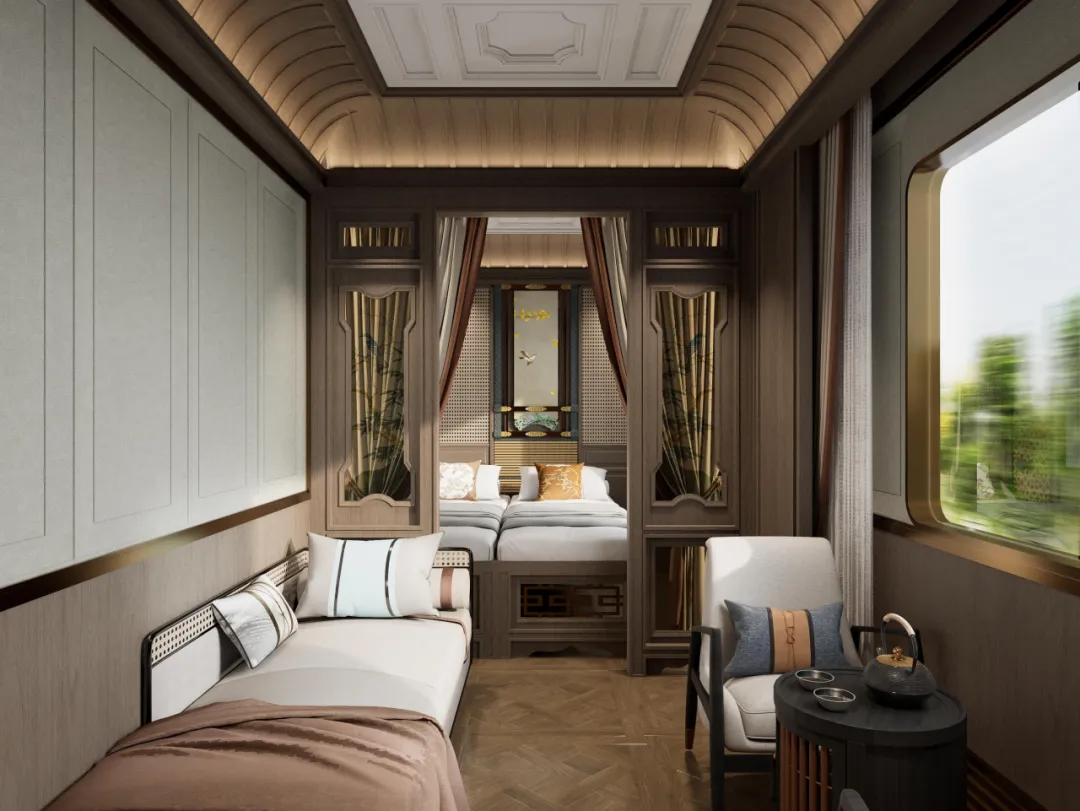
Among the most spacious suites in Chinese luxury rail at 13.7 m2. Each features a double sofa, mini refrigerator, mini bar, independent bathroom with dry-wet separation, and a floor-to-ceiling panoramic window. Twin beds can be combined for couples. These six suites sit in the top tier of the Chinese luxury train market.
13.7 m2Mini bar & fridgePanoramic windowDouble sofa
Yunqi Yayun · Premium Room
云栖·雅韵 · 40 rooms on the train
Forty premium double rooms at 10 m2, each with an independent viewing window and private bathroom. The refined choice for travellers who value privacy and comfort. All rooms feature Chinese classical interior detailing: cloud-pattern relief, lattice window motifs, and palace-lantern lighting that echoes the Ming and Qing scholarly study.
10 m2Private bathroomViewing window40 rooms
Yunju Xianting · Ceremonial Lobby
云聚·闲庭 · Chinese courtyard entrance
The first carriage sets the tone: a four-door ceremonial hall modelled on classical Chinese architecture. Cloud-pattern relief work, lattice windows, and palace lanterns frame the entrance. The cultural journey begins the moment you step aboard, not when you arrive at the first destination.
4-door entranceCloud reliefPalace lanterns
Yunyan Qinghuan · Dining Carriage
云宴·清欢 · 48-seat dougong-bracket restaurant
A 48-seat dining hall in the dougong bracket architectural style, set with Liling gilt porcelain. The kitchen serves a distinctive Cantonese-Hunan fusion menu: the subtlety of Guangdong cooking meeting the robust flavours of Hunan. Train dining standard: 168 RMB per person per meal.
168 RMB/mealCantonese-Hunan fusion48 seats
Yunshang Guanlan · Observation Carriage
云赏·观澜 · Garden pavilion on rails
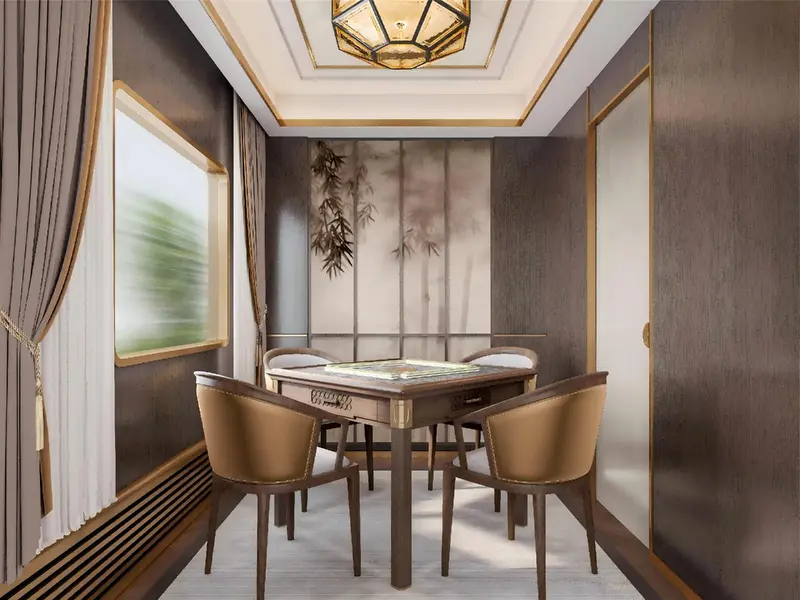
A panoramic observation carriage designed as a classical Chinese garden corridor. At its heart sits the "Aiwan Pavilion" (爱晚亭), a replica of the famous Yuelu Mountain pavilion where the literati of Changsha gathered for centuries. Tea is served. Weiqi boards are set. The landscape scrolls past through full-height flower-pattern windows.
Aiwan PavilionTea & weiqiPanoramic windows
Service & Cultural Programme
A dedicated cultural historian accompanies the journey, delivering Silk Road lectures in the mobile salon between Chongqing and Urumqi. The service team includes a starred butler, a professional photographer, a medical officer, and a full-time tour director. Evening activities range from calligraphy to Cantonese opera excerpts. The published staffing ratio is roughly one crew member for every two guests, which is why the service feels attentive rather than merely efficient. Ground transport uses 2+1 business-class coaches and 7-seat VIP vehicles for deep scenic access.
Cultural historianPhotographerMedical officerButler service
How the 18 carriages are laid out
The train runs on 25K-type rolling stock rather than the older 25G bodies that several other Chinese luxury trains were rebuilt from. Air-spring suspension, a coupling gap of just 7 mm between cars and folding wind deflectors at the vestibules keep the ride quiet and steady enough to sleep through. Over eighteen days that matters more than any cabin finish.
12 sleeping carriages
Every one with a private bathroom. Two are three-cabin cars holding the 6 suites, or 12 seats. Ten are four-cabin cars holding the 40 rooms, or 80 seats. That is 46 rooms and 92 guests across the whole train.
Kitchen, dining, lobby, viewing
Four public carriages carry the shared life of the train: a kitchen car where every meal is cooked to order, the restaurant car, the reception and lobby car, and an entertainment and observation car with 270-degree glazing.
Power car and staff car
The last two carriages never appear in a brochure: a generator car that lets the train supply itself on remote branch lines, and a crew dormitory, which is what allows a full service team to stay on board for the full eighteen days.
Comfort and access
Built around older travellers
适老化设计 · specified into the train, not added later
Most guests on a journey of this length are in their fifties, sixties or seventies, and the train was specified accordingly. The details are unglamorous and they matter: non-slip flooring runs the length of the train, every cabin carries an emergency call system, corridors are wide and step-free, the sleeping cars are insulated against running noise, and the kitchen plans menus around nutrition as well as flavour. A medical officer travels with every departure, carrying altitude and chronic-condition supplies. Travellers over 70 need a medical report issued within the previous six months plus a signed health acknowledgement, and those over 75 travel with a family member. A dedicated care attendant can be requested.
Non-slip flooringEmergency call in every cabinStep-free wide corridorsSound-insulated sleeping carsNutrition-planned menusOver 70s welcome, with medical report
Boarding at Guangzhou Baiyun Station
广州白云站 · the departure point for every sailing
The train boards at Guangzhou Baiyun Station, one of the largest integrated rail hubs in Asia, where high-speed, intercity and metro lines meet under a single roof. For travellers arriving from Hong Kong, Macau or Southeast Asia, that means one station, one transfer and no cross-city taxi. It is also why the White Cloud Express is the only Chinese luxury train that departs from southern China. If you would rather join the train further west, segmented boarding is available at Chongqing and Lanzhou. Guangzhou Baiyun Station is now the only station in the city that dispatches tourist charter trains: the Southern Train group's earlier service, the Xiangjiang (潇湘号), made its first departure from the old Guangzhou station in June 2025 and has left from Baiyun since its second journey.
The train's first Xinjiang departure ran on 7 September 2026, on the same eighteen-day itinerary set out below, and it was the only Xinjiang sailing of that year. Fares were RMB 108,880 for 云栖·揽月 Yunqi Lanyue and RMB 88,880 for 云栖·雅韵 Yunqi Yayun. Lanyue is the cabin now listed as 宽境 Kuanjing: the name changed for the 2027 season, the six suites did not.
The longest route in Chinese luxury rail. Eighteen days from the Pearl River Delta to the Pamir Plateau, using the classic "travel by night, explore by day" rhythm. The train serves as your fixed accommodation throughout: no packing and unpacking, no airport transfers, just a continuous unfolding of China's geography from subtropical Guangzhou to the high-altitude deserts of Xinjiang.
Two 2027 editions share this identical 18-day route: Tianshan Brocade (18 May to 24 Aug, 6 sailings, from RMB 98,880) and Golden-Wind Panorama (14 Sep, from RMB 108,880). Read the full day-by-day plan with Altay Route A/B and Yili-Kuqa Route A/B/C, or see the phased summary on the itineraries page.
Availability (operator chart, October 2026): the operator's current Xinjiang chart lists 6 June (two Yunqi Kuanjing suites open, Yayun open), 26 June (one Kuanjing suite open, Yayun open) and 14 September (Kuanjing suites may be releasable on request, Yayun open). The other published sailings do not appear on this chart; we are confirming their status with the operator. Rooms marked as releasable depend on operator coordination and are subject to written confirmation.
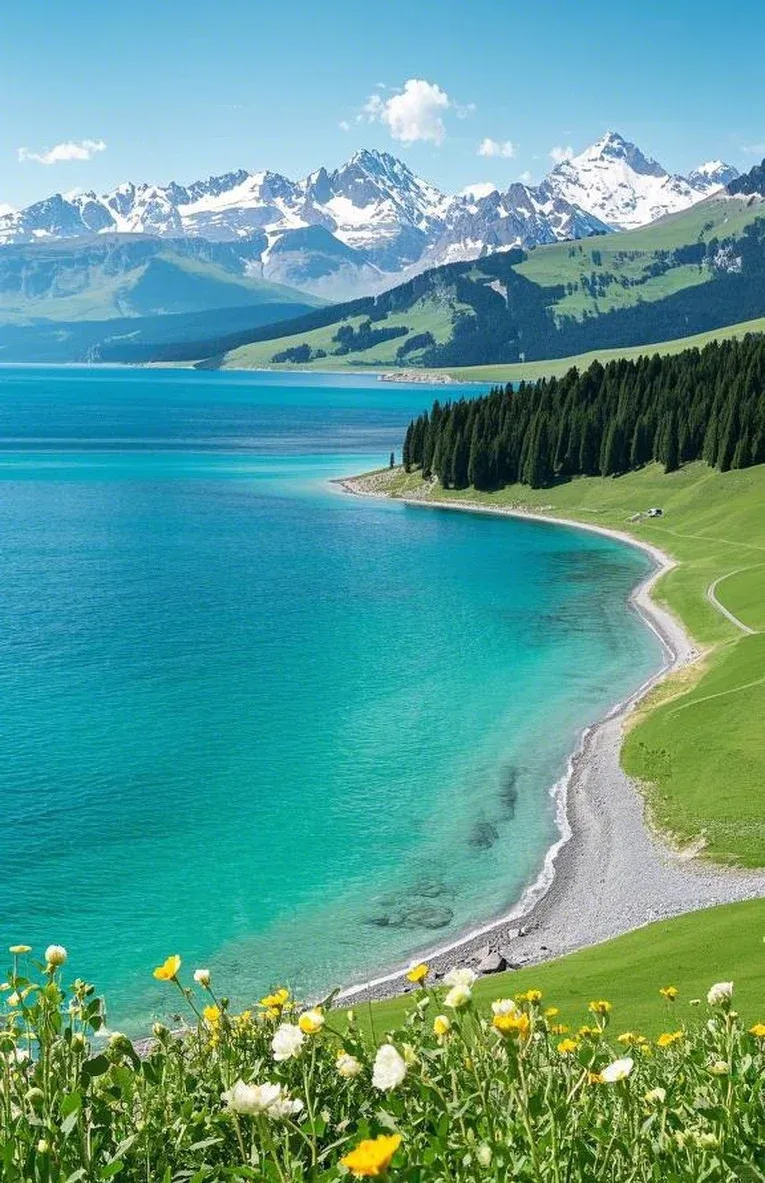
The route includes multi-choice segments for personalised exploration. In the Altay section, choose between Kanas Lake with Hemu Village (Line A) or Heavenly Lake with the Kazakh village of Chonghuer and Baihaba (Line B). The Ili-Kuqa segment offers three parallel routes: Sayram Lake and the Duku Highway (Line A), Sayram Lake with Nalati Grasslands (Line B), or the Yizhao Highway with Jade Lake and the Xiata Ancient Trail (Line C).
Duku Highway access for overseas travellers. The Duku Highway is open to mainland, Hong Kong, Macao and Taiwan travel documents. The Bayanbulak section alone is not open to holders of foreign passports; where an itinerary includes that section, foreign-passport guests travel a substitute routing arranged by the operator. Where an itinerary includes the Duku crossing, overseas guests travel a substitute routing arranged by the operator. Ask which routing applies to your specific departure, and confirm it in writing, before paying a deposit. Read the full Duku Highway guide.
Tianshan Brocade Edition · Panoramic Xinjiang
Six departures from May through August, 2027. Full north-south Xinjiang arc with multi-choice routing. Guangzhou → Chongqing → Urumqi → Altay (A/B lines) → Ili & Kuqa (A/B/C lines, Line C +6,000 RMB) → Kashgar → Pamir → Korla → Golmud → Guangzhou. Ili wildflowers, Duku Highway, Kashgar Old City, Pamir Plateau, Qarhan Salt Lake.
May 18, Jun 6, Jun 26, Jul 16, Aug 5, Aug 24 · From RMB 98,880/person
Golden-Wind Panorama Edition · Golden Xinjiang
One exclusive departure on 14 September 2027, the season's finale. The full north-south Xinjiang arc with multi-choice routing. Guangzhou → Chongqing → Urumqi → Altay (A/B lines) → Ili & Kuqa (A/B/C lines, Line C +6,000 RMB) → Kashgar → Pamir → Korla → Golmud → Guangzhou. Autumn golden larches of Kanas, the Duku Highway, Kashgar Old City, and the Pamir Plateau at its most luminous.
The second programme of the opening season, running from late September 2026, after the Xinjiang debut above. A round-trip loop through Guangxi and Yunnan: from Guangzhou south to the karst border town of Chongzuo, then westward across Yunnan's highlands through Kunming, Baoshan, Tengchong, Lijiang and Shangri-La, and back. A softer, lower-altitude companion to the 2027 Xinjiang panorama. From RMB 49,880 per person. The operator's full eleven-day day-by-day plan, with its Tengchong, Shangri-La and Lijiang options, is on the itineraries page.
Per person, twin-share. Upgraded-accommodation edition: +RMB 1,000.
3-Berth Suite · 3包房
From RMB 59,880
Per person, twin-share. Upgraded-accommodation edition: +RMB 1,000.
Boarding from Guangzhou. Reference fares in RMB, confirmed at time of enquiry. Source: 南方列车·白云号 official 2026 release.
Two halves of Xinjiang. North of the range is landscape: Kanas, Hemu, the Ili valley and Sayram Lake. South is the Silk Road: Kuqa, the ancient kingdom of Kucha, and Kashgar, with the Pamir plateau beyond. A programme that covers both is the one worth the days. Two notes for overseas travellers: the Bayanbulak section of the Duku Highway is not open to foreign passports (Hong Kong, Macao and Taiwan documents travel the full route), so those sectors run on a substitute routing for foreign-passport guests, and the Pamir sectors require an electronic border permit, arranged by your operator rather than by you. See the Xinjiang destination guide.
For international travellers
This train was specified for an overseas audience as much as a domestic one, and the onboard set-up shows it. English is the working language here, not an accommodation bolted on at the edges.
Language onboard
Bilingual Chinese-English butlers travel the whole journey, joined by Russian-speaking local guides at the destinations. Carriage signage, the journey handbook, menus and safety notes are all produced in both languages.
Payment and booking
Visa and Mastercard are accepted, and a multilingual online booking channel is open. As your English-speaking curator we handle the booking, suite selection and deposit regardless of how the operator's own system is set up.
Visas and border permits
Pre-travel visa guidance, Xinjiang border-area registration and document compliance checks are part of the service, so paperwork does not surface as a surprise two days before departure.
Dietary requirements
Halal, Western-style, gluten-free and vegetarian meals can be pre-ordered in the dining car. Tell us at the time of booking and the kitchen plans the 18 days around it.
What's Included
Included
+ White Cloud Express designated suite (entire journey as fixed accommodation)
+ Premium hotels at key scenic stops (5-diamond where available)
+ All meals: train dining at 168 RMB per meal (88 RMB breakfast); local dining at 100-150 RMB, with specialty meals at 150-200 RMB
+ All listed entrance tickets and scenic shuttle buses
+ 2+1 business-class ground coaches and 7-seat VIP vehicles for deep access
+ Cultural historian Silk Road lectures (Chongqing-Urumqi segment)
+ Starred butler, professional photographer, medical officer, tour director
+ Complimentary tea service in the Aiwan Pavilion observation carriage
Not Included
- Return transport to/from Guangzhou
- Single room supplement (amount TBC)
- Personal expenses, optional activities, and shopping
- Costs from force majeure (natural disasters, strikes, flight cancellations)
- Anything not explicitly listed as included
Photo Gallery
Frequently Asked Questions
Three things. First, it is the only Chinese luxury train with a literary, scholarly identity: every carriage is themed as a chapter in a classical Chinese residence, from the four-door entrance hall to the garden pavilion observation car. Second, it is the longest route in the market at 18 days, departing from Guangzhou rather than a northwestern hub, which makes it accessible to travellers from southern China, Hong Kong, Macau, and Southeast Asia without a domestic transfer. Third, the Cantonese-Hunan fusion dining programme is unique: no other luxury train serves this cuisine at 168 RMB per meal.
The train carries 92 guests total. There are 6 Luxury Suites (Yunqi Kuanjing) at 13.7 m2 each, featuring a double sofa, mini bar, mini fridge, and floor-to-ceiling panoramic windows, plus 40 Premium Rooms (Yunqi Yayun) at 10 m2, all with private bathrooms. The 13.7 m2 suites are among the largest in the Chinese luxury rail market.
Seven departures in 2027: six in the Tianshan Brocade Edition (May 18 through August 24) and one exclusive Golden-Wind Panorama Edition on September 14. The train departs from Guangzhou. As your English-speaking curator, China Expresses handles the booking process, suite selection, and departure-date matching. Contact us to register interest.
Travellers based in or connecting through southern China, Hong Kong, Macau, or Southeast Asia who want to avoid a domestic flight to Urumqi. Culture enthusiasts drawn to the Chinese scholarly aesthetic and the onboard lecture programme. Couples and small groups seeking some of the largest suites on Chinese rails. Photography enthusiasts who want 18 days of continuously changing geography from subtropical to alpine to high desert.
It was specified with them in mind. Flooring is non-slip throughout, every cabin carries an emergency call system, the sleeping cars are insulated against running noise, and menus are planned around nutrition as well as flavour. A medical officer travels with every departure, carrying altitude and chronic-condition supplies. Corridors are wide and step-free. Travellers over 70 need a medical report issued within the previous six months plus a signed health acknowledgement, and those over 75 travel with a family member; a dedicated care attendant can be requested. Two things about the format help as much as the hardware: the train stays your fixed accommodation for the whole journey, so there is no daily packing and no repeated hotel check-ins, and the route uses the "travel by night, explore by day" rhythm, which keeps the long distances happening while you sleep. Guests in their sixties and seventies are the norm on Chinese luxury rail rather than the exception.
Every sailing boards at Guangzhou Baiyun Station, one of the largest integrated rail hubs in Asia, where high-speed, intercity and metro lines meet under one roof. Coming from Hong Kong, Macau or Southeast Asia you reach it without a domestic flight, which is the main reason this train exists: it opens a southern gateway to Xinjiang instead of routing you through Urumqi. Segmented boarding at Chongqing or Lanzhou can be arranged if you would rather join the train further west. Return transport to and from Guangzhou is not included in the fare, so plan your international arrival to land with a day in hand.
Baiyun district has stated three directions for the programme: Xinjiang, the south-west, and Northeast China. The Xinjiang circuit is the one with published 2027 dates, and the south-west Yunnan loop runs through to December 2026. The northeastern routes are announced as an intention rather than a timetable, so treat them as a direction of travel rather than something bookable. If a northeastern departure matters to your planning, register interest and we will tell you the moment the operator confirms dates.
They can, and the operator publishes a service standard for children under 12 that covers train meals, ground transport, entrance tickets and shuttle buses, destination meals and the guide service. In practice the guest profile skews strongly to travellers in their fifties, sixties and seventies, and the cultural programme, the lecture series and the eighteen-day length all assume an adult audience. For multi-generational groups we would usually point you towards the Panda Express Chengdu instead, which is built around family cabins.
The White Cloud Express opens a southern gateway to Xinjiang and the Silk Road. Ninety-two seats. Seven departures. Two curated editions. From RMB 98,880.
Booking Policy
Booking flow, the cancellation ladder, the Route C supplement and 2027 availability.