
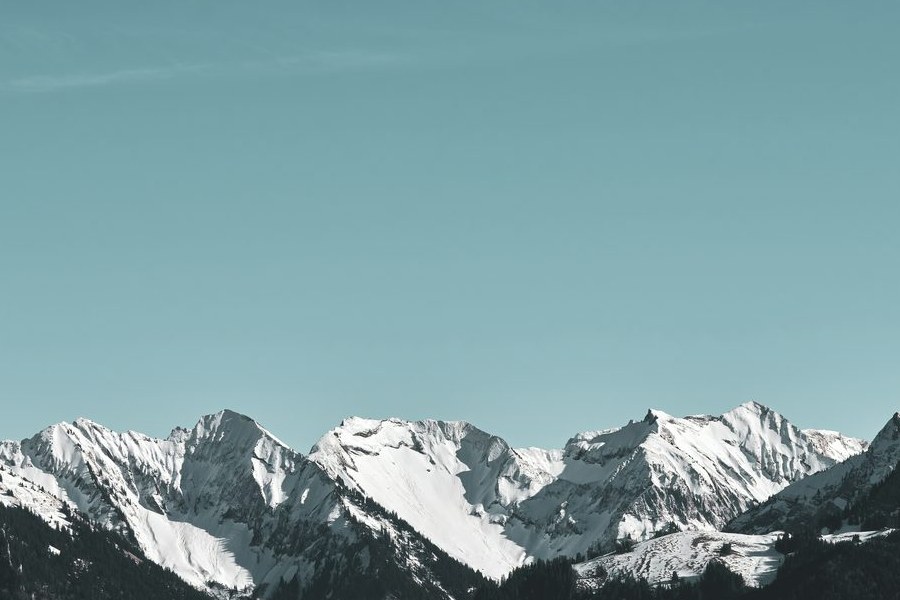
Every Xinjiang itinerary in this market mentions the Duku Highway. Almost none of them explain it, and that is a problem, because it is the only external variable that genuinely moves the price of a departure. The same train, the same cabin, the same number of days, can differ by RMB 8,000 per person between April and September, and the reason is a 561 kilometre mountain road that is closed for two thirds of the year. This is what the road is, when it opens, what it does to fares, and the part that matters most to an overseas buyer, which almost nobody publishes.
What the road is
The Duku Highway is the common name for a section of national highway G217 running north to south across the Tianshan range, from Dushanzi in Karamay to Kuqa in Aksu prefecture. It is 561 kilometres long. Half of it sits above 2,000 metres, and the high point, the Hasilegen Pass, is about 3,400 metres and keeps year-round snow; the Tielimaiti Pass and its tunnel, at roughly 3,220 metres, mark the divide between the northern and southern halves.
It was built as a military strategic route. Work started in August 1974 and finished in September 1983, and 168 builders died doing it, roughly one for every three kilometres. There is a memorial at Qiaoerma, roughly where the northern and central sections meet, and Chinese travellers treat stopping there as part of the road rather than an optional extra. If your itinerary includes Qiaoerma, that is why.
The reason it appears on so many luxury rail itineraries is simple: it compresses the crossing of the Tianshan into a single day, and it does so through landscape that changes from glacier to grassland to red canyon within a few hours. There is no rail equivalent. For a train operator running a Xinjiang loop, the Duku is the day that sells the brochure.
The three sections
Operators almost always say “Duku Highway” as though it were one thing. It is three, and they are not equally available.
| Section | Route | Distance | Character |
|---|---|---|---|
| Northern | Dushanzi to Qiaoerma | approx. 185 km | The dramatic one. Canyon, glacier, the Haxilegen Pass, four seasons in a day. |
| Central | Qiaoerma to Bayinbuluke | approx. 140 km | High alpine grassland, gentler driving, the Bayinbuluke wetland. |
| Southern | Bayinbuluke to Kuqa | approx. 230 km | Tielimaiti tunnel, the Dragon Pools, then red sandstone down to the Kuqa Grand Canyon. |
Distances are the figures in common circulation and are approximate; published segment boundaries vary slightly between sources. Last verified October 2026.
Four months a year
The road crosses a range that holds snow at altitude for most of the year, so it is closed by snow and reopened by snow clearance. It is not a soft or negotiable date. In 2026 it opened on 1 June; in 2025 it closed on 10 October at 20:00; the 2026 season ended on 8 October at 20:00, and reopening next June is expected but never guaranteed. That gives a season of roughly four months, and every Xinjiang train programme is built inside it.
| Window | Duku status | What operators do instead |
|---|---|---|
| April to late May | Closed | Spring editions run the northern and southern loops without the crossing. Cheapest sailings of the year. |
| June to August | Open | Peak season. Lavender in Ili, longest daylight, and the Duku on the itinerary. |
| September to early October | Open, weather dependent | Golden season. The most expensive sailings, and the ones with real closure risk if snow comes early. |
| Mid-October to May | Closed | No Xinjiang luxury train programme runs in this window. |
One detail from 2026 worth knowing, because it affected how the road was actually driven: with the G3033 Duku expressway and the Yi–A railway both under construction, the northern section ran under a daytime-traffic, night-time-construction regime, generally 08:00 to 19:00 for private vehicles, with some stretches flexed to 21:00. During the summer peak the northern section also operated a reservation system capped at 3,000 small vehicles a day across five entry windows. These are road-management measures that change year to year. For a train passenger they mostly matter as a reason the excursion day starts early.
What it does to your fare
The clearest published example in this market is the New Orient Express, which splits its 2027 programme into three priced editions and states plainly whether the Duku is in them.
| 2027 edition | Duku | Imperial | Supreme | Per day |
|---|---|---|---|---|
| Spring, 3 sailings | Not included | RMB 58,999 | RMB 65,999 | RMB 4,214 |
| Summer, 6 sailings | Open | RMB 62,999 | RMB 68,999 | RMB 4,500 |
| Autumn, 3 sailings | Open, golden season | RMB 66,999 | RMB 72,999 | RMB 4,786 |
Fourteen-day journeys, per person on a twin-share basis. Per-day column uses the Imperial fare. Single supplement RMB 8,000.
Now the honest part, which is where most coverage of this gets lazy. The gap from spring to autumn is RMB 8,000, but the Duku only explains part of it. Spring to summer is RMB 4,000 and the Duku is the reason. Summer to autumn is another RMB 4,000, and the Duku is open in both, so that second step is about September light and harvest colour, not about the road. If you are weighing whether the Duku is worth paying for, the number to look at is the first step, not the second.
The other trains handle it differently. The Jinxiu Tianfu states that its 2 October 2027 sailing does not include the Duku crossing, which is exactly the kind of line that is easy to miss when you are comparing dates. The White Cloud Express publishes a Yili to Kuqa choice of three routes, A through the Duku, B via Sayram Lake and Nalati, C via the Yizhao highway, with a stated fallback if the road is shut. The Jinxiu Dongfang lists Kuqa and the Duku in its published 16-day routing. Three operators, three different ways of telling you whether you get the road. Our 2027 calendar carries the Duku status as a column for exactly this reason.
The overseas traveller problem
This matters to our foreign-passport readers more than to anyone else, because they are the ones the Bayanbulak restriction covers. The practical consequences are worth spelling out.
- You travel a substitute routing, not the Duku. Some reporting suggests overseas visitors are occasionally taken along the northern section, Dushanzi towards Nalati, which sits outside the restricted zone. Treat that as a possibility rather than something you are entitled to, and never as something to budget for.
- The substitute is a different day, not a shorter one. A replacement routing usually means another road and another set of stops, so the shape of that day changes. Ask what it is, not merely whether there is one.
- Xinjiang border zones need a permit regardless. Tashkurgan, the Pamir plateau, Khunjerab and similar areas require an electronic border defence permit. Since April 2026 these have been issued electronically rather than on paper, and they are arranged by the operator or the licensed agency, not by you. Ask who arranges it and whether it is included.
- Not every hotel on the route is licensed for foreign guests. This is a known friction point in Bayinbuluke and Kuqa. A train programme that has handled overseas passengers before will have solved it; ask how many foreign-passport guests sailed last season.
None of this is a reason to avoid Xinjiang. The northern Duku, the Pamir plateau, Kashgar and the Turpan basin are all open to overseas visitors with a valid visa and the right permits, and they are extraordinary. It is a reason to check what your specific departure actually delivers before paying for a promise.
What you are actually paying for
If the Duku is not on your itinerary, do not pay for it. That is the practical takeaway from everything above: a summer surcharge justified by a road you cannot travel is money spent on somebody else's day. What you are buying instead is the rest of Xinjiang, and it is worth being specific about it, because operators frequently are not.
Northern Xinjiang is the landscape half. Kanas and Hemu in the Altay, birch and larch around an alpine lake; the Yili valley and the Nalati grassland; Sayram Lake; the spruce forests and summer pastures along the northern slopes of the Tianshan. This is where most of the photography comes from, and it is open to overseas visitors without restriction.
Southern Xinjiang is the Silk Road half, and it is the reason to come. Kuqa, the ancient kingdom of Kucha, with the Kizil Thousand-Buddha Caves, the red sandstone Tianshan Grand Canyon and an old town of painted doors. Kashgar, with its mud-brick old city, the Id Kah mosque and the Sunday livestock market. And beyond it the road south to Tashkurgan and the Pamir plateau: Karakul Lake and Muztagh Ata along the Karakoram highway. Tashkurgan and the Pamirs sit in a border management zone, so an electronic border defence permit is required; it is arranged by the operator rather than by you, and you should confirm that it is included.
A useful way to read any Xinjiang itinerary is to check that both halves are properly covered. A programme heavy on the north and thin on the south, or one that sells the Duku and says little about Kuqa, Kashgar and the Pamirs, is selling you the wrong thing.
The seven-seat rule, and what it means on the ground
Vehicles with more than seven seats are prohibited on the Duku Highway, along with trucks and trailers. That single rule shapes the logistics more than anything else in the itinerary, and it is worth understanding because it explains a number of things operators do not volunteer.
A 92-guest train cannot move over the Duku in coaches. It has to move in a fleet of small cars, roughly one vehicle per cabin, which is a genuinely different experience from a coach convoy: no headcounts, no fixed regrouping times, and a driver who can stop when the light is good. A 66-guest train needs fewer vehicles for the same effect, which is one of the quiet arguments for the smaller programmes. It is also why the New Orient Express inclusion list specifies 7-seat vehicles for the Duku sector rather than merely saying transport is provided.
The corollary is that the Duku day tends to be a long one. Section speed limits on the road are enforced at 30 to 40 km/h in places, the northern section alone takes four to five hours with stops, and the whole road is two to three days end to end for a self-driver. A train programme will cover one selected portion in a day, not the full length. If a brochure implies otherwise, it is being loose with the word Duku.
Five questions to ask before you book
- Is the Duku crossing on my specific departure date, in writing? Not on the programme generally. On 13 September, for example.
- Which section, and how far? Northern only, or through to Kuqa. These are different days and different photographs.
- Which routing replaces the Duku on my departure? Not whether there is one, there always is. Which one, and what does it actually cover.
- If the road is closed, what replaces it? Route B, an extra day in Ili, or nothing. The quality of the fallback tells you how much the operator has thought about it.
- Who arranges the border defence permits, and are they included? If the answer involves you attending an office in Urumqi, the programme is not set up for overseas guests.
If you would rather not run that interview yourself, send us the departure and we will ask it for you. We are not the operator and we do not take the booking, which is precisely why we can ask questions an agent would rather not put in writing.
What changes by 2032
The G3033 Duku expressway is under construction, and the wider Kui–Duku corridor is reported for completion before 2032. When it opens, the crossing is expected to take about four hours instead of the better part of a day, and to run year round. If that happens, the seasonal logic described on this page stops applying: the four-month window disappears, the autumn premium loses one of its supports, and Xinjiang luxury rail becomes a product that can plausibly run in October and November. It will also change what the road feels like, because a tunnel-and-viaduct expressway is not the same journey as a mountain road with a memorial at the top.
Worth noting for anyone booking 2027 now: none of this affects you. Every departure in the 2027 calendar runs on the existing road under the existing seasonal rules.
Where the numbers are soft
Opening and closing dates are set by the Xinjiang transport authorities and adjusted for weather, so the 1 June and 10 October figures above are last season's actuals rather than a standing rule. Segment distances are the ones in common circulation and differ slightly between sources. The restriction on foreign passports at the Bayanbulak section is a standing one rather than a seasonal or discretionary one, but access rules along the road are applied locally and can shift without notice, so even a substitute routing confirmed at booking is worth re-checking in the fortnight before departure. Verification channels for road status change frequently, and the reservation scheme described above applied to the 2026 summer peak only.
Treat this page as the questions to ask rather than the answers. The underlying point survives all of that: on a Xinjiang luxury train, the road is the variable, and it is worth more than the thread count. For the wider picture on how fares are built, see how to read a Chinese luxury train quote, or work through the comparison tool with the season in mind.