
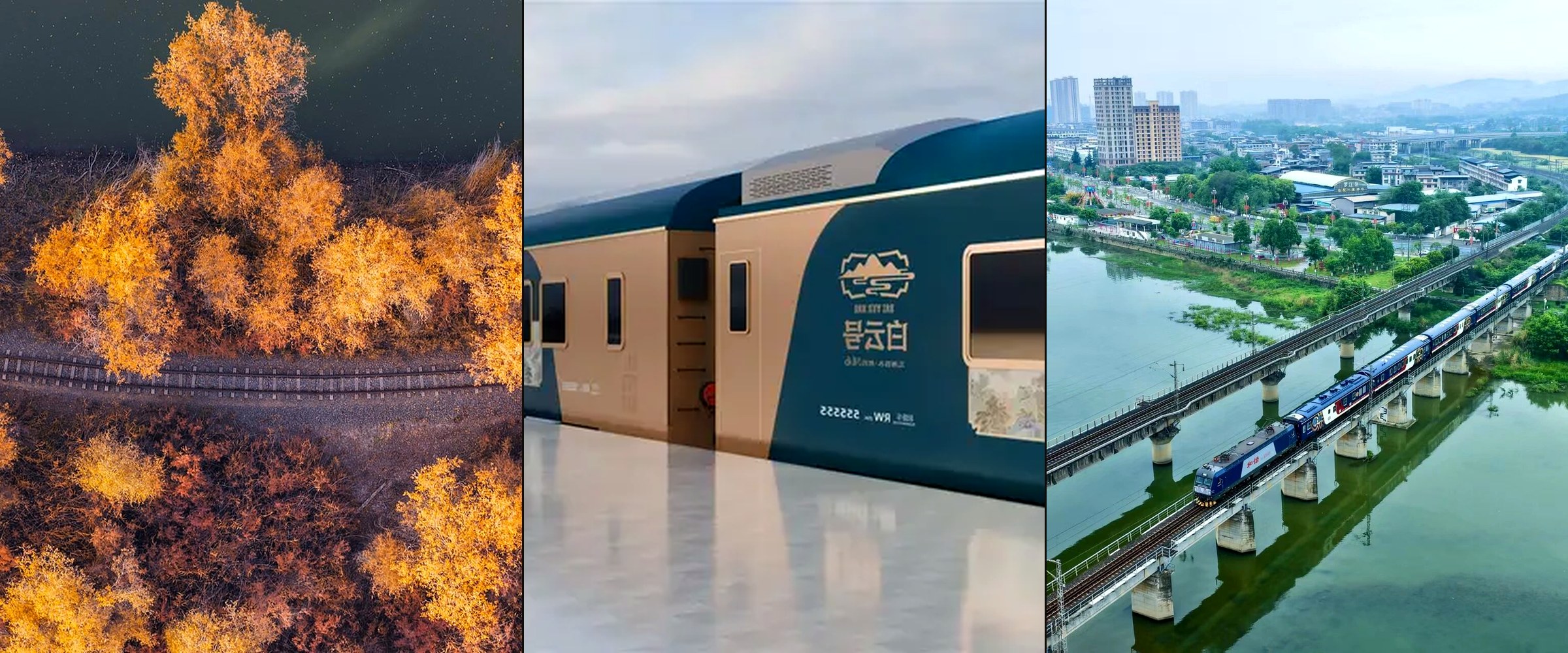
The White Cloud Express is a moving Chinese scholarly residence: 18 carriages styled on the four-fold order of a scholar's academy, with a ceremonial lobby, dining and observation cars. It boards at Guangzhou Baiyun Station, the only luxury fleet departing South China. Two programmes define its calendar.
Programme one · the 2026 southwest loop (Sep-Dec)
Seven departures run a round trip through Guangxi and Yunnan: south from Guangzhou to the karst border town of Chongzuo, then west across the Yunnan highlands and back. The published routing calls at, in order:
Chongzuo · the karst border
Guangxi's border country, where the landscape turns to karst towers hard against the Vietnamese frontier. The loop's first taste of the southwest.
Kunming · the Spring City
Yunnan's capital and the traditional gateway to the province's highlands, at a gentler altitude than the destinations that follow.
Baoshan & Tengchong · the western frontier
Yunnan's far west toward the Myanmar border: volcanic country, hot springs and the WWII-era history of the old Burma Road corridor around Baoshan and Tengchong.
Lijiang & Shangri-La · the highlands
The UNESCO-listed old town of Lijiang and the Tibetan frontier town of Shangri-La close the loop at altitude, before the train returns east to Guangzhou. The operator positions this programme as a softer, lower-altitude companion to the 2027 Xinjiang panorama; the detailed day-by-day sight list is published with each departure.
Programme two · the 2027 Xinjiang panorama
The 2027 inaugural season takes the train to Xinjiang with a programme the operator describes as two halves. North of the Tianshan is landscape: Kanas, Hemu, the Ili valley and Sayram Lake. South is the Silk Road: Kuqa and the ancient kingdom of Kucha, Kashgar, with the Pamir plateau beyond. A programme covering both is the one worth the days, in the operator's own framing.
Two notes for overseas travellers on the Xinjiang programme: the Bayanbulak section of the Duku Highway is not open to foreign passports (Hong Kong, Macao and Taiwan documents travel the full route), so those sectors run on substitute routing for foreign-passport guests; and the Pamir sectors require an electronic border permit, arranged by the operator rather than by you.
Chongqing · the fiery send-off
The journey opens with Chongqing's signature hotpot and night views from the Raffles City crystal sky deck before the train points west, a one-evening taste of the mountain city's street-side energy.
Altay · a Kazakh family feast
In the Hemu and Kanas leg, the operator tables a Kazakh family feast alongside the regional tastings, and the cold-water fish feast of the Kanas waters appears further south at Sayram Lake as the prized whitefish lunch.
The Ili valley · grassland fires and sunset on the water
On the Kalajun routing, dinner is followed by a bonfire evening on the grassland; the Yili combinations that run through the valley tables add a sunset dinner served on a boat as the day closes.
The Pamir finale · a Tajik family visit
Near Tashkurgan, a visit to a Tajik family home brings eagle-flute and eagle-dance performances, both listed as national intangible heritage, with a yak hotpot dinner in Tashkurgan and a roast-lamb banquet waiting in Kashgar.
Fares at a glance
- · Southwest loop (7 departures, Sep-Dec 2026): four-berth room from RMB 49,880, three-berth suite from RMB 59,880, per person twin-share; upgraded-accommodation edition +RMB 1,000.
- · Xinjiang panorama (2027): see the train page for the published 2027 structure.
Based on the Nanfang Lieche Baiyun Hao official 2026 release and published 2027 descriptions. Sight sequences are set per departure; confirm the day plan and written fare breakdown for your date before paying a deposit.