

This is our first-look analysis, written when the 2027 programme was announced. It is about what the train means and what we could and could not verify. For the cabin specification, the five themed cars and every published 2027 date, use the Jinxiu Dongfang train page.
The panda fleet is adding a fourth train. Jinxiu Dongfang (锦绣东方号) is billed as the family’s new flagship for 2027 and as China’s first Han-Tang themed train, and it is built around a number that no other train on the network can match: 66 seats across 18 carriages. For comparison, Jinxiu Tianfu carries 92, the Silk Road Express carries 80, and the Chengdu carries 108. If you have been waiting for the most exclusive thing on Chinese rails, this is the one to watch. It is also the one to approach with a little patience, because it is brand new and not everything about it is confirmed yet.
Verdict first
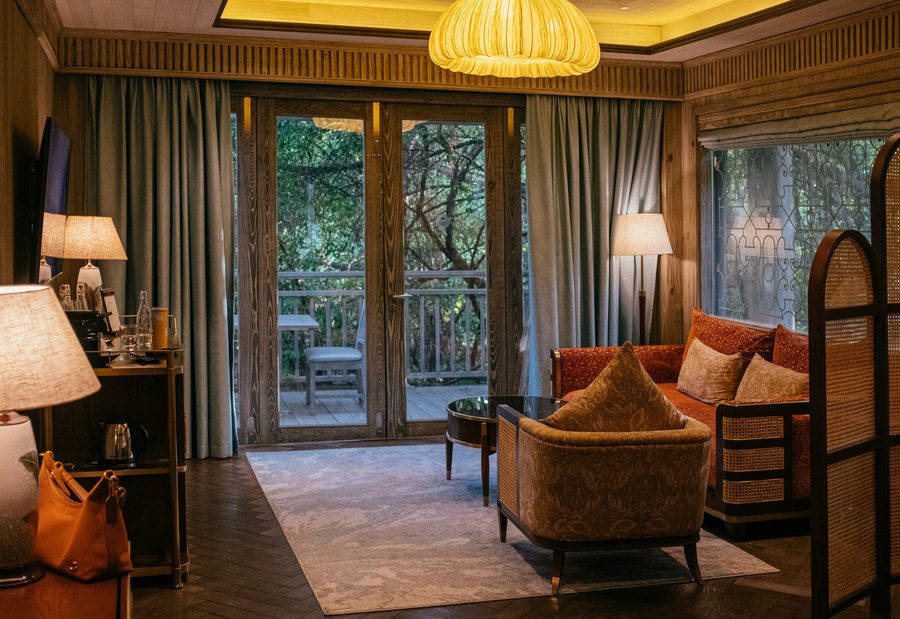
Jinxiu Dongfang is a low-density, high-touch train aimed squarely at travellers who find 90-odd fellow passengers too many. It pairs the smallest guest count of any Xinjiang programme with the largest standard suite in the panda family (around 15 m2), a claimed 1:2 staff-to-guest ratio, and what is described as China’s first twin restaurant car configuration. The Hulunbuir Express carries fewer still at 44, but it runs Inner Mongolia rather than Xinjiang. The trade-off is price: at RMB 138,888 per person for the standard season it sits well above Jinxiu Tianfu and roughly double the Chengdu. It runs one route in 2027, a 16-day north and south Xinjiang circuit from Chengdu, with eight departures between May and September.
Why 66 seats is the number that matters
Guest count is the single most honest indicator of what a Chinese luxury train actually is, more reliable than any star rating or marketing tier. Here is why. Eleven of the eighteen carriages are sleepers, and each sleeper holds three cabins, not the usual four to six. That single decision cascades through the whole product: wider cabins, fewer people at every excursion, fewer people queuing for the two restaurant cars, and a ground operation that can run one vehicle per cabin rather than a coach per forty people.
It also explains the price. A train that carries 66 instead of 108 has to recover a similar fixed cost from roughly 40 per cent fewer travellers. When you see a fare of RMB 138,888, you are not paying for a longer itinerary or a more exotic destination than the Chengdu, which covers much the same ground. You are paying for the empty space around you.
The headline numbers, against three rivals
| Jinxiu Dongfang | Jinxiu Tianfu | Chengdu | Silk Road Express | |
|---|---|---|---|---|
| First season | 2027 | May 2026 | 2025 | 2024 |
| Cars / guests | 18 / 66 | 18 / 92 | 18 / 108 | 15 / 80 |
| Cabins per sleeper car | 3 | not published | 4 to 5 | not published |
| Suite size | approx. 15 m2 | 13 m2 top tier | 10 m2 top tier | up to 22 m2 |
| Restaurant cars | Two (Wei Jinyan + Zun Jingong) | One | One | Two |
| Design theme | Han and Tang dynasty | Shu brocade, Song dynasty | Panda, Sichuan | Han green-and-blue Silk Road |
| Staff ratio (claimed) | 1:2 | 1:0.5 | not published | 1:2.2 |
| Boards at | Chengdu or Lanzhou | Chengdu (+ Lanzhou) | Chengdu | Xining |
| 2027 from | RMB 138,888 | RMB 79,880 | RMB 66,999 | on application |
The twin restaurant cars, and what they reveal
Every new train here claims a design theme, and themes are cheap. This one also claims something harder to fake: two restaurant cars on a single train. Wei Jinyan (味锦宴) carries Sichuan flavours; Zun Jingong (尊锦宫) is staged as a Han-Tang palace banquet hall. Nobody else in China does it, and the reason is arithmetic rather than ambition. A restaurant car is the most expensive square metre on a train and the hardest to keep full, so two of them only make sense when the guest count is low enough to overflow one and the fare is high enough to carry the dead space. In other words, the twin restaurants are not a luxury add-on; they are a consequence of the 66-seat decision, and they are the clearest signal of what this train is for.
The other three spaces are a reception car, the accommodation cars and an observation bar that converts to a performance space in the evening. We describe all five, with the car-by-car layout, on the train page.
The route, and where a first season tends to slip
One itinerary is published for 2027, a 16-day circuit out of Chengdu covering both halves of Xinjiang: Baihaba, Kanas and Altay, the Ahe and Tiejia highways, Yining, Urumqi, Sayram Lake, the Yizhao highway, the Mengket ancient road, Kuqa, the Duku highway, Kashgar, the Kiziliya Grand Canyon and the Pamir plateau. That is close to the maximum a single trip can hold, and it is worth saying plainly that itineraries this long are exactly where a first season shows strain. Three things have to work first time: the Duku Highway has to be open on the day you cross it, a party of mixed ages has to cope with the Pamir at altitude, and a ground operation running one vehicle per cabin instead of shared coaches has to hold together across sixteen days.
None of that is a reason to avoid the train, and the underlying pattern, travel by night and explore by day, is the right one. It is a reason to book with a buffer and to hold your plans loosely until the season has a few departures behind it. The full routing and the day-by-day shape are on the train page.

What it costs, and the tier that does not add up
Eight departures are published in two tiers: six at RMB 138,888 per person on the Tianshan Pastoral edition, and two at RMB 158,888 on the Gilded Ode autumn edition. Both are twin-share and all-inclusive. At RMB 8,681 a day this is the most expensive train in the country by a wide margin, and the gap over the Jinxiu Tianfu at RMB 4,993 a day is not buying a longer route or a better destination. It is buying the space around you.
One thing does not add up, and we would rather say so than tidy it away. The two autumn sailings fall on 27 August and 13 September, both of which are earlier than the 30 September departure that is listed under the standard-season tier. We have reproduced the schedule exactly as published and have asked the operator which reading is correct. Until we hear back, do not build a plan around the tier names. Every departure is listed individually on the Jinxiu Dongfang train page, and all five 2027 programmes sit side by side in our 2027 departure calendar.
Fares are all-inclusive and quoted per person on a shared-cabin basis, which is standard across the panda fleet. A whole-car charter is also offered, quoted per carriage rather than per person, and that figure should not be read as a per-person price. As with every train here, there is no public ticket channel: seats are allocated through authorised agents, and you should expect to confirm the fare, the cabin layout and the inclusion list in writing before paying a deposit. Our booking guide walks through the sequence.
How it sits against the rest of the panda family
The panda fleet now spans a wide price band, and the logic is cleaner than it first looks. The Chengdu is the entry point at RMB 66,999 and carries the most people. Jinxiu Tianfu sits in the middle at RMB 79,880 with a Song-dynasty design programme and 92 seats. Jinxiu Dongfang takes the top slot at RMB 138,888 with 66 seats and the twin restaurant cars. All three start in Chengdu and all three run Xinjiang, so the choice is genuinely about how much space and how much attention you want rather than about where you go. We keep a standing train page for the new flagship with the full specification, and our fleet ranking covers where each train lands once it has a season behind it.
Why we are not ranking it yet
We publish a fleet order, and Jinxiu Dongfang is not in it. That is not a view on quality, it is a rule: we rank a train once it has completed a season with confirmed dates and confirmed fares. On paper this one would place high, because 66 guests and roughly 15 m2 beat the Jinxiu Tianfu’s 92 and 13 m2 on both of the measures we weight most heavily. On paper is not the same as on board. A first season carries teething problems that no specification sheet captures, from a galley finding its rhythm to a crew learning a route, and ranking a train before it has carried a single paying guest would be a guess presented as an assessment. Once the 2027 season has a few departures behind it, we will place it.
What is still unconfirmed
We would rather flag these than paper over them, because a new train always has gaps between the brochure and the boarding pass:
- Imagery. Published cabin and interior visuals are computer renderings. The operator has not released photography of the finished train.
- Car body type. Sources differ on whether the train is built on a 25K or a 25G platform. This affects ride quality and top speed, so it is worth confirming if it matters to you.
- Tier naming. The autumn departures (27 Aug, 13 Sep) fall before the 30 Sep departure that is listed under the spring and summer tier. We have reproduced the dates as published and asked for clarification.
- Fares and dates. All 2027 pricing is subject to the railway’s final operating plan and to the signed travel contract. Treat every figure here as a reference point, not a quote.
If the density argument appeals and the price does not, the Jinxiu Tianfu at 92 seats and RMB 79,880 covers much the same scenery for close to half the fare. If you want the very largest suites on the network rather than the fewest neighbours, the Silk Road Express still holds that title with 22 m2. Ask us to put all three side by side for your dates.