
Sources. Long-form travel diaries, verified-rider Q&A threads and guest interviews posted on Chinese platforms, 2025 to September 2026. Quotations are translated from Chinese and lightly condensed. Nothing on this page is sponsored.
Xinjiang is a quarter of China's land area. Its headline sights sit hundreds of kilometres apart, connected by roads that eat daylight. That geography is the entire pitch of the New Orient Express: cover the distance at night, in a bed, and wake up at the next highlight. Nearly every review opens by testing that promise. Most conclude it holds.
A guest from Shenzhen travelled the southern Xinjiang loop with his wife and in-laws, four cabins' worth of family. His verdict after twelve days, which he scored 8.5 out of 10: on his previous self-drive tour of northern Xinjiang, half of every day went to the road, with several eight-hour driving days. On the train, daily coach time dropped to three or four hours. The family spent the moving evenings playing cards in the lounge car, slept in real beds, and checked into five-star ground hotels at the far stops.
"This is not a train ticket. It is a villa that runs along the snow line."
A guest travelling with his parents and young child, 2026 season.
The same rhythm is why reviewers keep recommending the train for specific travellers: parents in their seventies and eighties, children too young for twelve-hour drive days, and anyone who has already done Xinjiang by road once and does not intend to repeat the coach hours. One reviewer's father, in his eighties and initially hesitant, ended the trip calling it the most comfortable tour he had ever taken.
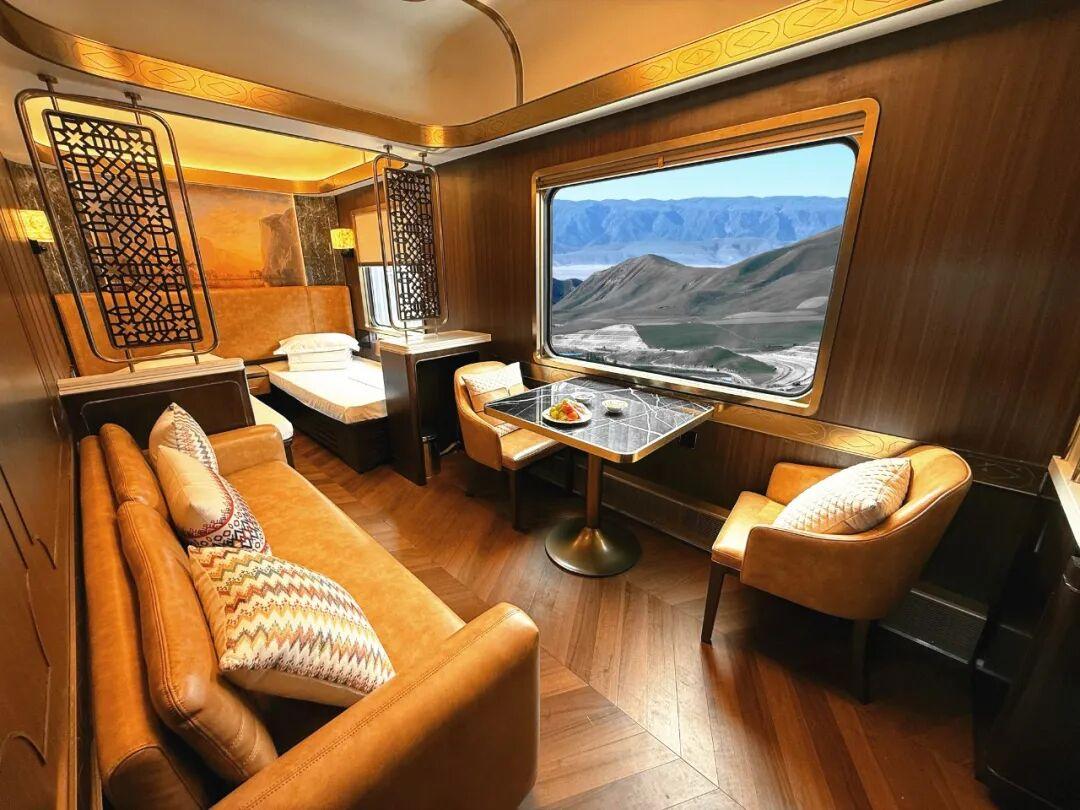
Reviews are unusually blunt that the two cabin tiers are two different products. The top suites carry a wide bed, a separated wet-and-dry bathroom, a wardrobe, a safe and a small fridge, and guests photograph them like hotel rooms. The entry grade trades the private bathroom for a lower fare: four berths, a large picture window, and shared toilets and showers at the end of the car. Riders on that tier describe the shared facilities politely as "functional, and cleaned constantly", then book the higher grade next time.
Practical notes from guests who measured with their luggage: the cabins are compact by hotel standards, and a large suitcase does not fully open flat. Pack for the wardrobe, not the floor. Wi-Fi exists but does not blanket the whole route, contrary to some marketing copy. And the train is audible at night; light sleepers pack earplugs.
If the reviews have one enthusiasm in common, it is the food. Two dining cars serve rotating menus built on Silk Road regional cooking, and reviewers enumerate: hand-pulled noodles, lamb, chicken over big plates, fruit that tastes like the orchard it came from. Suite guests can order served to the cabin. The bar car carries a piano and bartenders who mix Xinjiang-flavoured cocktails; several reviews mention evenings ending there.
"Every dinner was six dishes and a soup, and no dish repeated across the whole trip. We stopped trying to guess the region and just enjoyed the geography lesson on the plate."
A traveller on a 2026 departure, in a verified-rider Q&A thread.
A physician and nurse ride along on the full circuit, and reviewers meet them early: health checks are offered onboard, medications are logged, and at demanding excursions the medical team positions themselves at the hard part. A photographer on the train describes the 1,068-step climb to the lake overlook at Kanas: "the doctor was waiting at the bottom of the stairs the whole time. That changes how bold you are willing to be at 70." For many reviewers, this is the detail that converted hesitation into a booking.
One geographic note for overseas travellers: the famous Duku Highway crossing that features in many Chinese reviews closes its Bayanbulak section to holders of foreign passports, while Hong Kong, Macao and Taiwan documents can travel the full route. Where an itinerary includes the Bayanbulak crossing, foreign-passport guests travel a substitute routing arranged by the operator. The train's northern highlights, Kanas, Hemu, Sayram Lake, the Ili valley, are fully open.
Read across the threads, the profile is consistent: travellers who want Xinjiang's full sweep in one trip without living on a coach; families spanning three generations; and celebrants, the reviews include chartered carriages for university reunions, with the class singing around the piano while the desert goes by. Guests who need independent pacing, or who judge holidays by attractions per day, say so plainly in the same threads: this is not their format.
Publicly available accounts are translated or condensed only where the originating publication can be identified. Individual platform posts may be deleted, private or login-gated; they are not represented as independently auditable evidence. Qualitative observations are editorial synthesis, not a statistically representative sample. Last reviewed .