
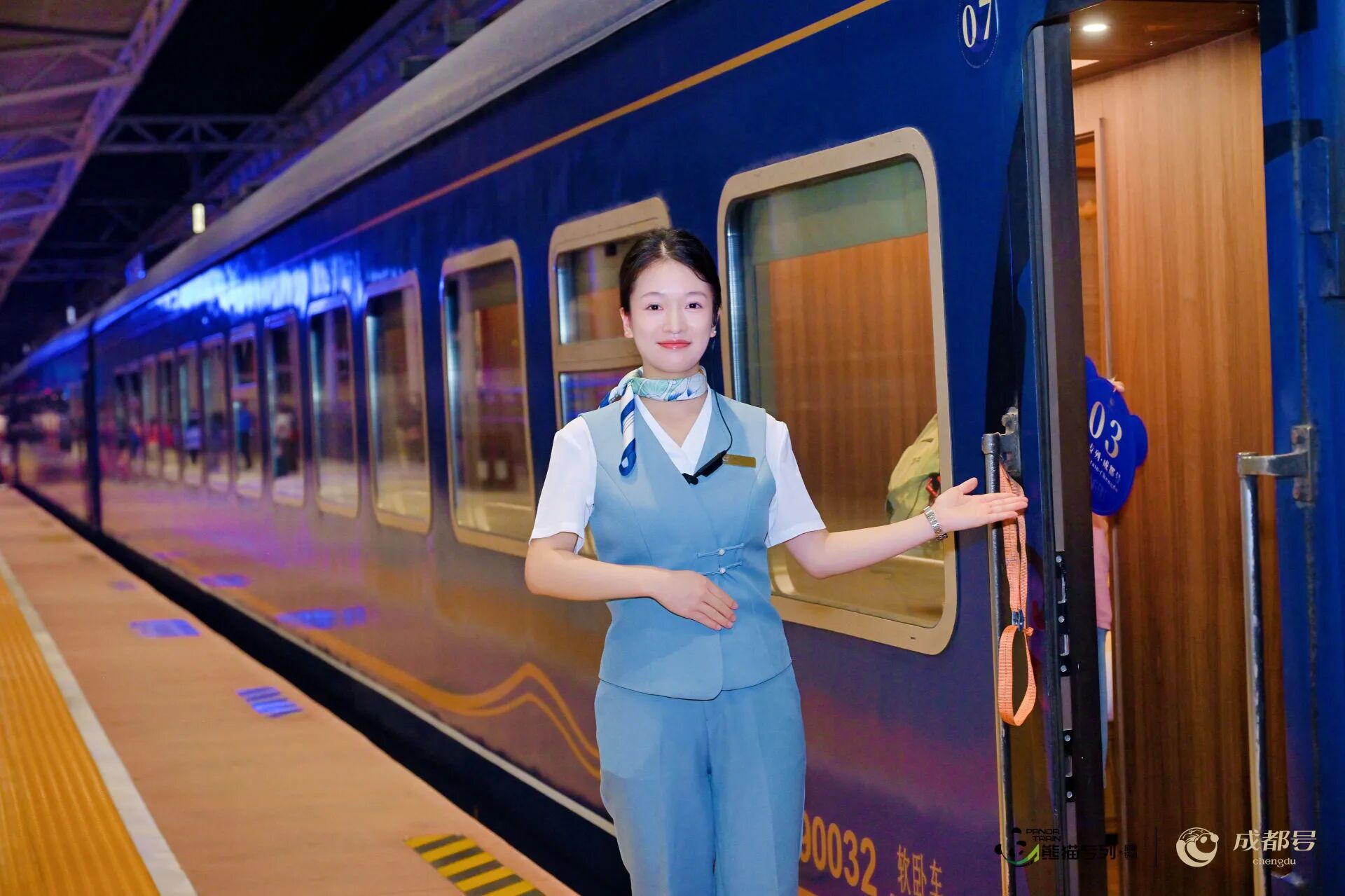
The newest wave of China’s luxury rail market has produced three trains so similar on paper that choosing between them looks impossible. Each is an eighteen-car formation. Each carries fewer than 110 guests in fully en-suite cabins. Each stages evening performances, runs a dedicated dining operation, and prices its 2027 Xinjiang season between RMB 67,000 and RMB 129,000 per person. And yet they are genuinely different machines, built by different state-backed consortia with different design languages, different service philosophies and different ideas about what a guest should do at ten in the evening. This page takes them apart piece by piece.
The contenders: Jinxiu Tianfu (锦绣天府号), Sichuan Tourism Investment’s Song-dynasty flagship and the newest of the panda fleet; the White Cloud Express (白云号), the Guangzhou-led consortium’s literati-styled first entry; and the Panda Express Chengdu, the Chengdu Culture & Tourism group’s quality benchmark.
Why these three and not the obvious others: they are direct competitors — same generation (2025–26), the same core Xinjiang route, overlapping fare bands — which is what makes a cabin-by-cabin comparison useful. The Silk Road Express (丝路梦享号) plays in a league of its own on exclusivity — 38 suites for just 80 guests and a 1:2.2 staff ratio — and is best read as a step up rather than a rival. The New Orient Express spans three configurations from RMB 16,800 to 72,999, so it gets its own dedicated comparison.
The headline numbers
| Jinxiu Tianfu | White Cloud | Panda Chengdu | |
|---|---|---|---|
| Railway bureau | Chengdu + Sichuan Tourism Investment | Guangzhou + Bay Area investors | Chengdu + Chengdu Culture & Tourism |
| In service | 19 May 2026 | 2026 (launch 25 Aug) | 2025 |
| Cars / cabins / guests | 18 / 46 / 92 | 18 / 46 / 92 | 18 / 54 / 108 (132 max) |
| Design theme | Song dynasty × Sichuan brocade | Lingnan literati interiors | Panda IP × Tianfu scroll |
| Cabin tiers | 2 | 2 | 2 |
| All en-suite | Yes | Yes | Yes |
| 2027 Xinjiang from | RMB 79,880 | RMB 98,880 | RMB 66,999 |
| Top-tier 2027 | 108,880 | 128,880 | 74,999 |
| Boarding city | Chengdu (+ Lanzhou) | Guangzhou | Chengdu (+ Lanzhou) |
Fares are channel-published reference rates per person, twin share, for the 2027 Xinjiang season. The White Cloud’s 14 September sailing rises to RMB 108,880 / 128,880.
Cabins: where the money actually goes
All three run two cabin tiers, all en-suite with separated wet and dry zones. The differences are in square metres, count and finishing.
| Train | Top cabin | Size / count | Standard cabin | Size / count |
|---|---|---|---|---|
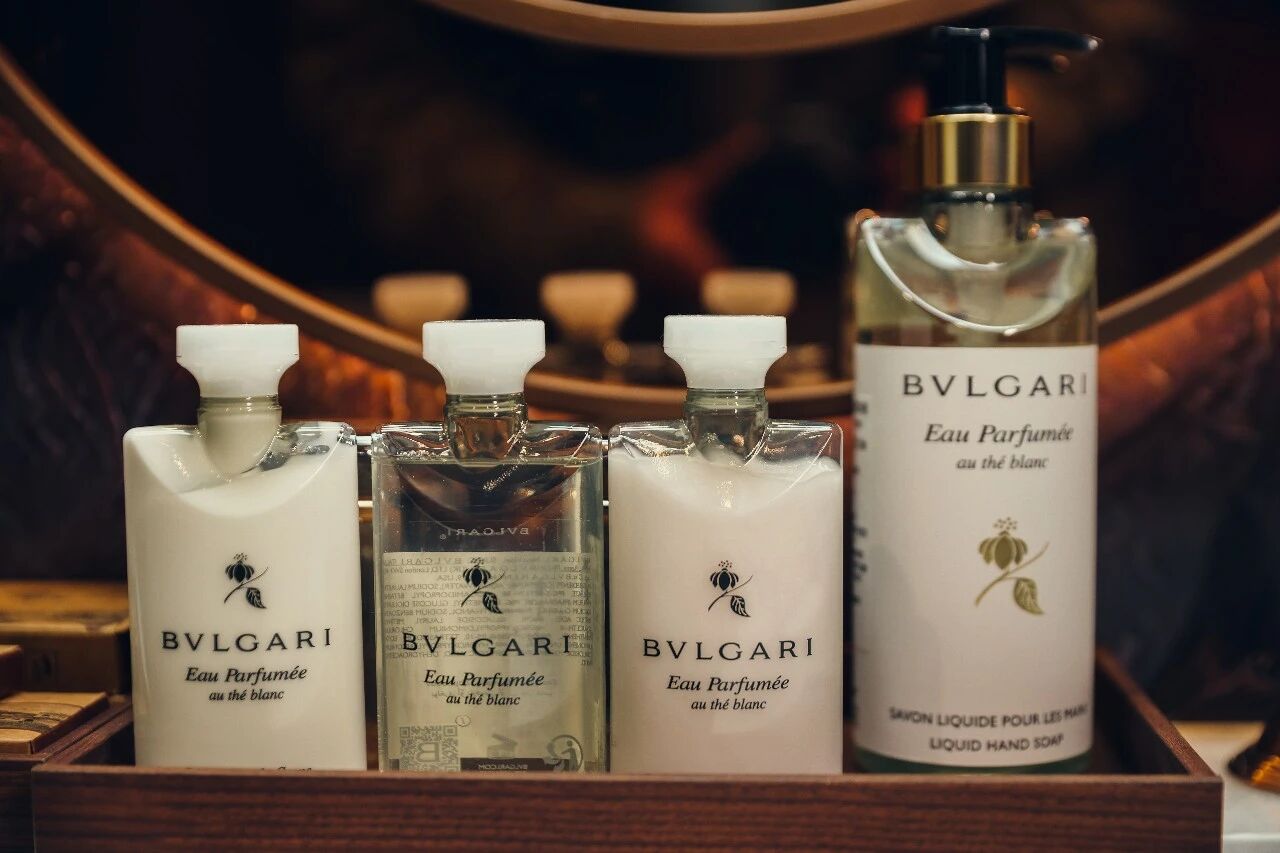
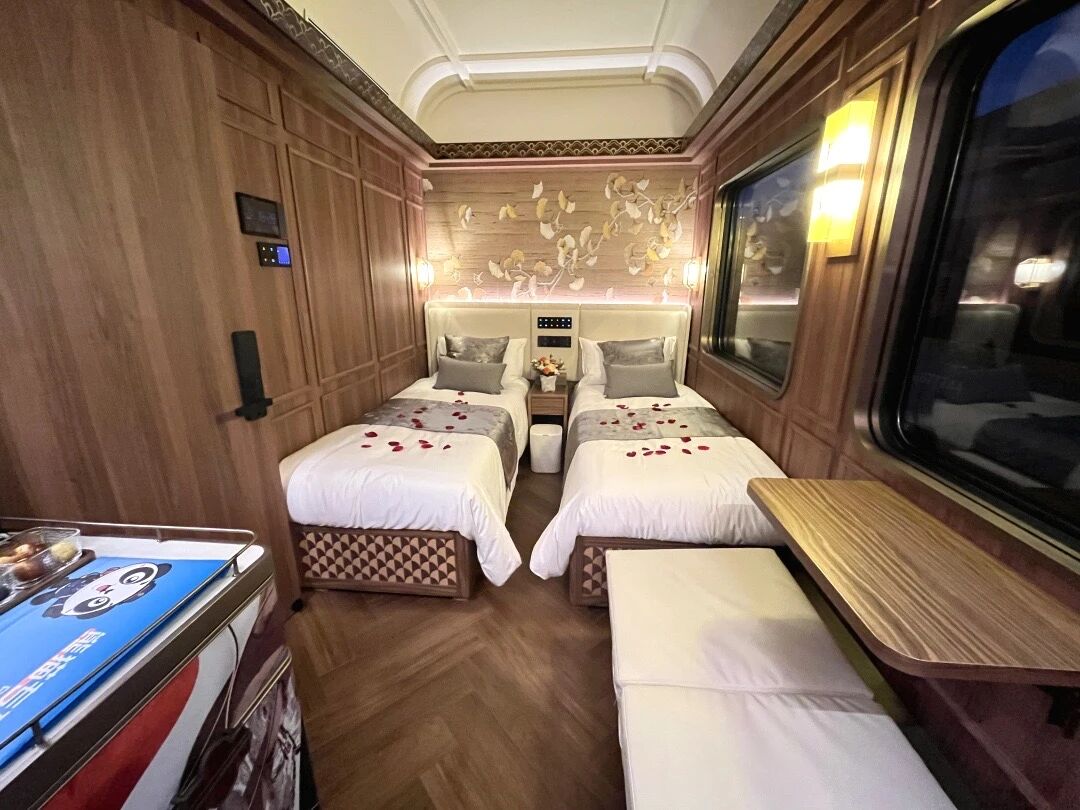
| Jinxiu Tianfu | Jinta 蜀韵栖居 — twin convertible, silk-screen sitting area, Bvlgari amenities, TOTO, Dyson, capsule coffee | 13 m² / 6 cabins | Jinwo 蜀境栖云 — twin + folding sofa, mini-bar | 10 m² / 40 cabins |
| White Cloud | Kuanjing 云栖·宽境 — VIP observation cabin, 270° panoramic constant-temperature window | — / part of 46 | Yayun 云栖·雅韵 — VIP observation cabin, same window spec | — / part of 46 |
| Panda Chengdu | Shi Yi Ju 诗意居 — configurable king/twin/family (2+2), voice-controlled lighting, mini-bar, 1.5 m window | 10 m² / 24 cabins | You Ran Ju 悠然居 — twin | 8 m² / 30 cabins |
Three practical readings of that table. First, scarcity: the Jinxiu’s top cabin exists in just six units — the scarcest berths in the market — which is why its fare ladder steps highest. Second, family logic: only the Chengdu’s Shi Yi Ju reconfigures for two adults plus two children; on the other two trains, a family of four needs two cabins. Third, the window question: the White Cloud’s 270° panoramic glazing is its single strongest hardware claim and is stated for both tiers; the other two specify large picture windows rather than wrap-around ones.
Public space and dining: three philosophies
This is where the trains truly diverge, because each operator has answered “what do 100 people do for sixteen evenings?” differently.
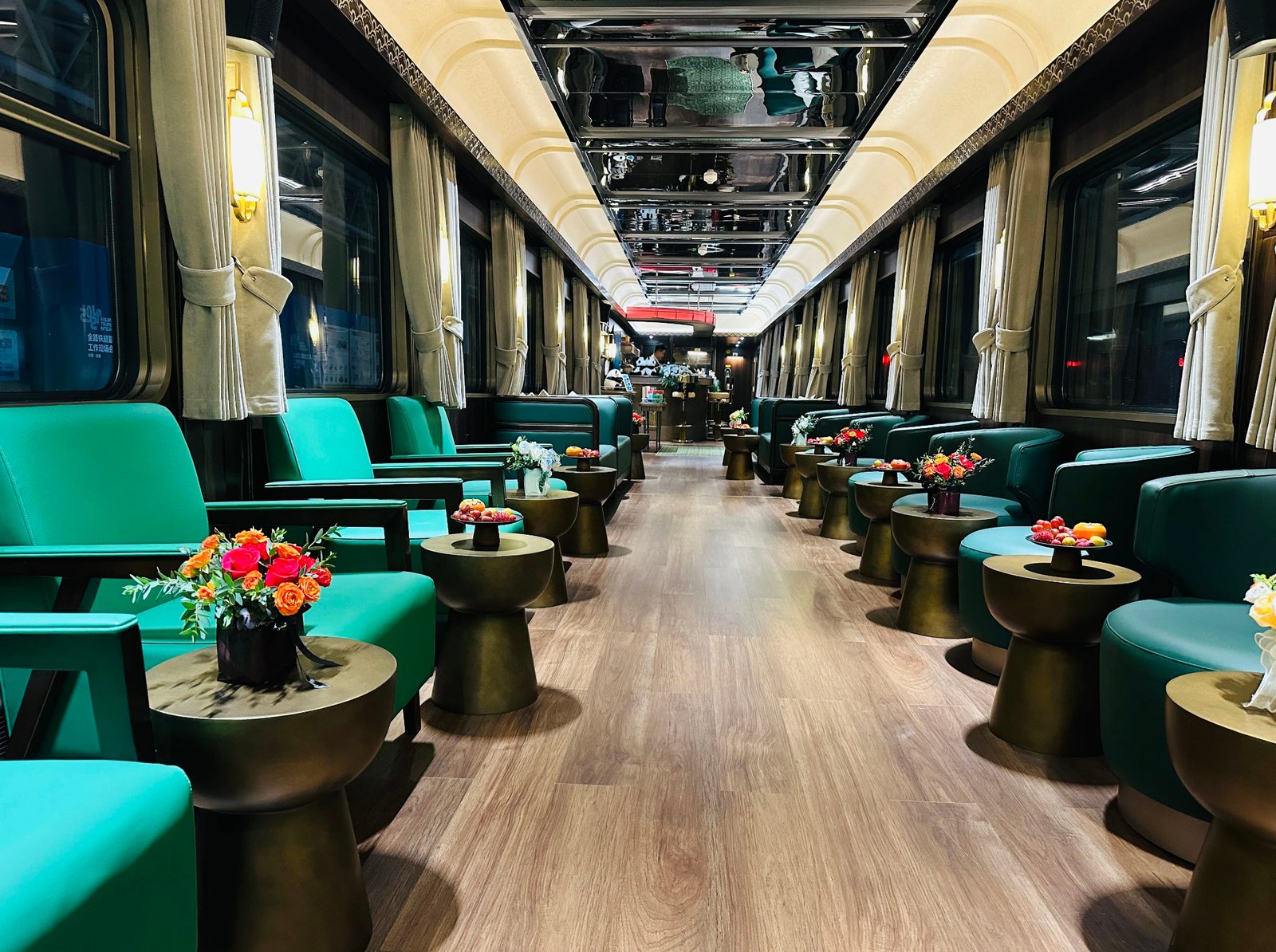
Jinxiu Tianfu organises the train into five zones (五域): sleeping, a reception domain with private tea pavilions, a dining domain seating 54 adults plus 9 children, and a 360° panorama lounge. The dining car runs seven Song-themed menus under a Michelin-trained resident chef, and daily intangible-heritage workshops — guzheng, rattan weaving, calligraphy — are part of the schedule, not an optional extra. The tone is scholarly and unhurried; you are meant to feel hosted in a private collection.
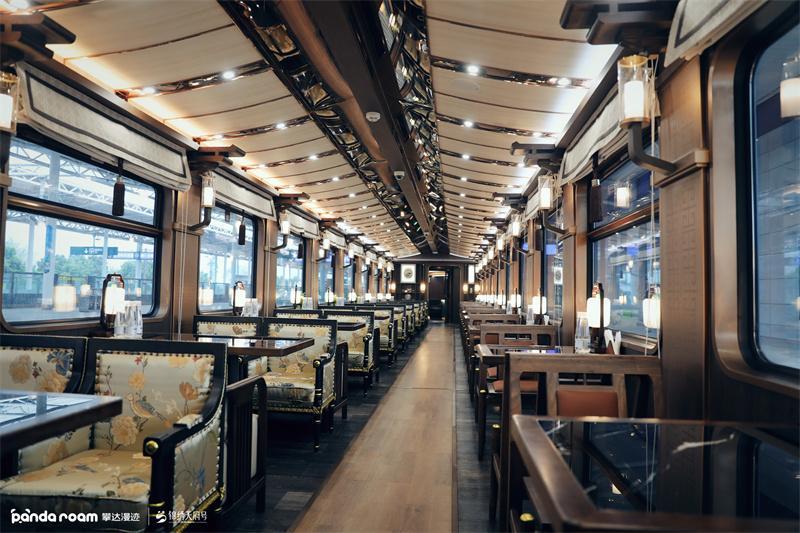
White Cloud names every car in a “cloud” (云) sequence and stages its public rooms as literati interiors: the Yunyan Qinghuan restaurant car serves Michelin-trained fusion cuisine, while the Yunshe Guanlan multi-function car and a welcome lounge host cultural sessions. The design references Lingnan window lattice and Guangzhou arcade architecture — it is the only one of the three whose cultural anchor is southern China, and the only one boarding in the south.
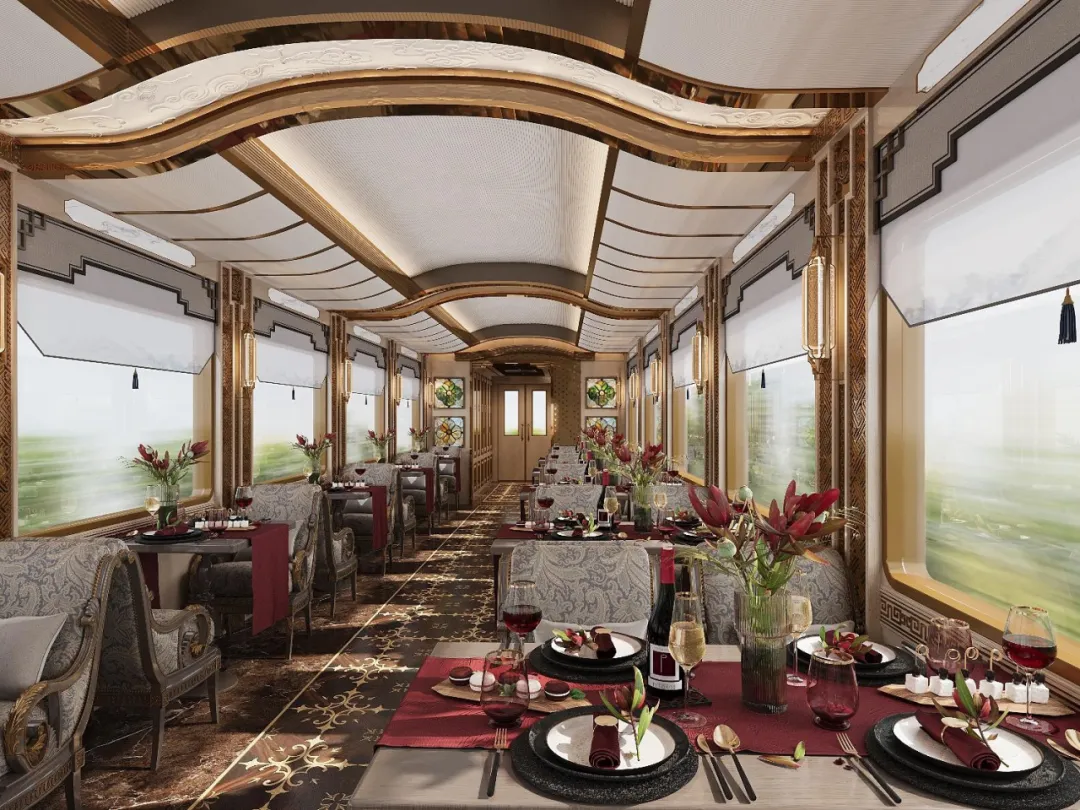
Panda Chengdu is the most theatrical. Its dining operation pairs one kitchen car with one restaurant car (the Jinshi Hui, 54 covers behind 1.5-metre picture windows), and the evening programme is the busiest of the three: Sichuan opera face-changing and folk performance in the bamboo-themed Yuefu Hall, KTV and cinema in the Liuyun Pavilion, plus a corridor gallery displaying nearly 60 pieces of national-level intangible heritage. It is the warmest and loudest of the three ships — deliberately so.
Service: who looks after you
Two of the three now publish the same headline number: a staff-to-guest ratio of 1:0.5. The Jinxiu has stated it since launch — roughly two staff per guest across its 92-cabin load, including Les Clefs d’Or-badged butlers, dual guides, a 24-hour luggage team and licensed medical staff keeping per-guest health files. The White Cloud matched it in its full product release of 25 August 2026. The Chengdu fields a documented specialist team — 18 cabin butlers, resort ambassadors, six guides, eight chefs, two medics and a photographer behind a 50-plus support staff — which works out near 1:0.7 including kitchen and technical crew. All three carry medical cover; the Jinxiu’s health-file system is the most formalised.
Language matters here. The Chengdu and Jinxiu have carried the highest inbound shares in the market (the Chengdu’s debut sailing was 59.6% international, the Jinxiu’s first season around 90%), and both operate with bilingual butler coverage as a result. The White Cloud now publishes its own international-guest provision — bilingual service, Visa/Mastercard payment, visa and border-permit assistance, and tailored dietary options (halal, Western, gluten-free, vegetarian) — a sign of where it expects its market to come from. See our piece on who actually rides these trains.
Dining standards are now published at similar precision. The White Cloud specifies breakfast at RMB 68, onboard lunch and dinner at RMB 168, and shore meals at RMB 100–180 with festival menus at the top of that band. The New Orient Express’s third generation runs RMB 150 for onboard meals; the entry-level trains sit near RMB 35–40. Top-tier dining is not merely “better” — it is a different budget line entirely.
Routes and seasons
- Jinxiu Tianfu — the widest programme. 2027 Xinjiang runs two editions (Tianshan Pastoral: 19 May, 5 Jun, 22 Jun, 9 Jul, 26 Jul, 2 Oct; Gilded Ode: 29 Aug, 15 Sep) at RMB 79,880–108,880. Uniquely, it also runs a nine-day southwest winter loop (Chengdu–Xichang–Lijiang–Shangri-La–Dali–Baoshan–Tengchong–Kunming) from RMB 39,880 — the shortest flagship product in China, and the only one that leaves Xinjiang. See Yunnan and Xinjiang.
- White Cloud — two loops from Guangzhou. A Yunnan southwest line from September 2026 (the train’s first route, from RMB 49,880 in the four-berth tier) and the 2027 Xinjiang season described above. The operator has also named a north-eastern winter direction — treat it as intent rather than a schedule until dates appear. Boarding in Guangzhou makes it the natural pick for anyone entering via Hong Kong or the Bay Area.
- Panda Chengdu — one route, perfected. The 16-day north-and-south Xinjiang loop, seven departures across Midsummer (4 Jun, 21 Jun, 8 Jul, 25 Jul, 11 Aug) and Autumn Gilt (28 Aug, 14 Sep) editions. Several 2027 sailings sold out within weeks; 2028 is already open. Single-minded, but the operation shows it.
A route nuance that affects flights: the Jinxiu and Chengdu board in Chengdu (with Lanzhou as an alternate), while the White Cloud boards in Guangzhou. For travellers from Europe, both work; for anyone combining Hong Kong or Southeast Asia, the Guangzhou departure removes an internal flight.
The verdict
- Choose Jinxiu Tianfu if you want the most scarce and most finished cabin in the market, the deepest cultural programming, the widest choice of routes — and you are comfortable at the top of the price ladder. It is the connoisseur’s pick.
- Choose the White Cloud if the 270° window and a southern boarding city matter, if you want the strongest published provision for international guests (payment, visas, dietary), or if you want to pair two regions (Yunnan now, Xinjiang in 2027) on the same design language.
- Choose the Chengdu if you want the most premium experience at the lowest entry of the three, the most flexible family cabin, and the liveliest evenings — and you are happy trading RMB 30,000 of budget against the other two’s extra polish. It is also the most battle-tested: a full season of inbound-heavy sailings behind it.
However you lean, book early and book formally: all three are sold as all-inclusive packages through authorised channels (none appears on 12306), deposits are what actually hold a cabin, and the peak-season allocations go first. Our booking guide and the 2027 price table cover the mechanics.
Compare All Trains →Ask Us to Decide For You
Sources: operator and authorised-channel releases for each train (May–August 2026), China News Weekly on the Chengdu’s service team and debut manifest, and China Tourism News (June 2026) on fleet specifications; White Cloud service ratio, dining standards and international-guest provision from its full product release (25 August 2026). Cabin counts for the White Cloud’s two tiers are not yet published separately (46 total); staff ratios are operator statements. Fares are channel-published reference rates — confirm for your date and cabin before paying a deposit.