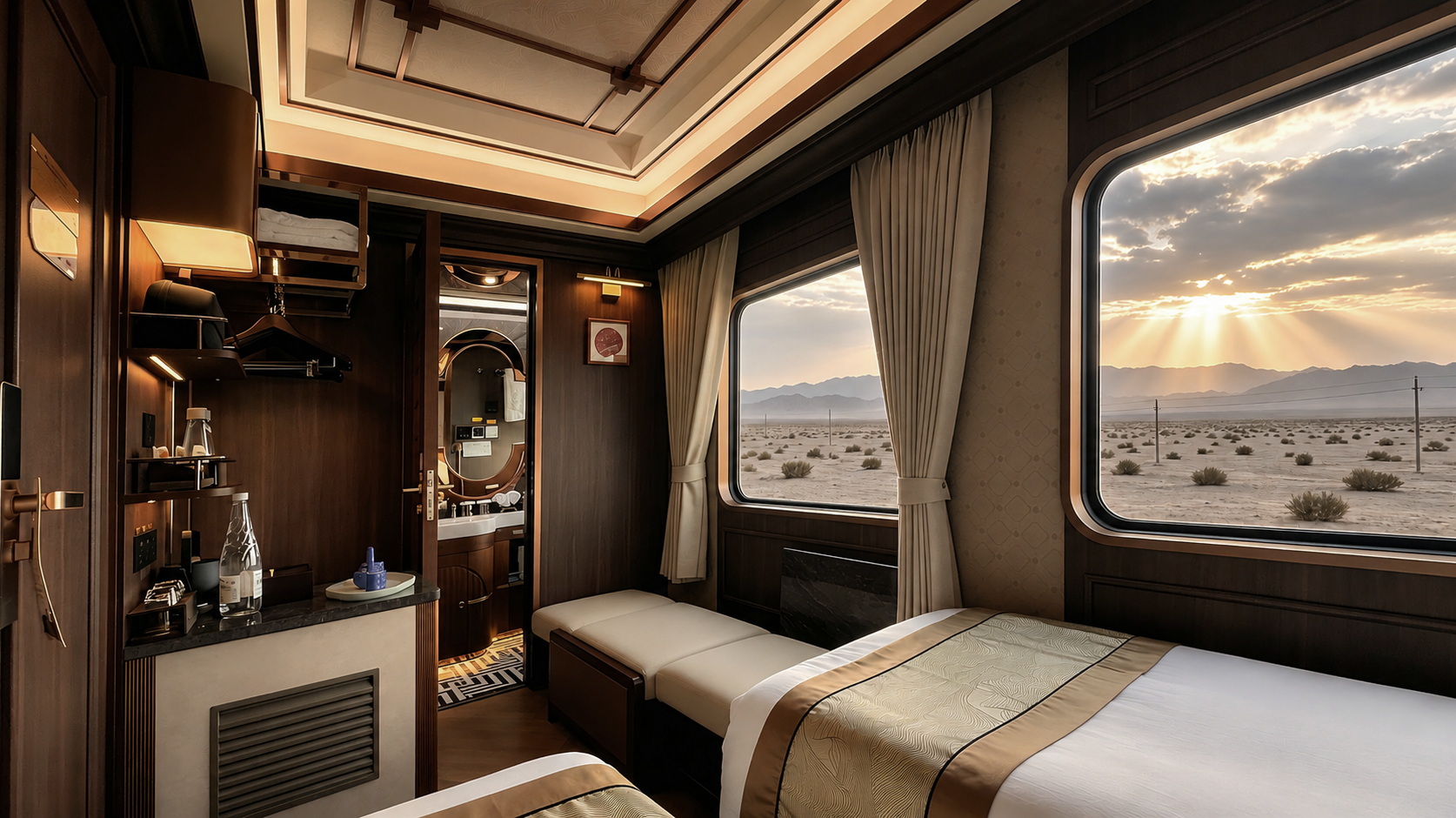
The Jinxiu Tianfu carries 46 rooms for 92 guests, and the operator's handbook bills the whole fleet as high-end suites. Beyond the rooms, the handbook describes five themed public spaces and a design language built on Song-dynasty aesthetics, Shu brocade and the landscapes the train runs through. This page collects what the operator's vehicle handbook publishes.
The operator positions the train around Shu brocade and Song-dynasty style: period design details, five themed shared spaces and a programme of Song-era pursuits on board. The five spaces below come straight from the operator's vehicle handbook; their exact fit-out can vary and the handbook is the reference for your sailing.
Five themed public spaces
The welcome hall
A double-door entrance hall with timber beams and columns, flower-lattice partitions in a ruyi fret pattern, and garden-style landscaping that shifts view by view as you move through.
The observation lounge
Song-style framed picture windows treat the landscape outside like a scroll painting. Recessed movable tables sit beneath a gold-latticed, light-permeable ceiling; a bar counter carries Song-vessel motifs in celadon tones, water-ripple textures echo the Liujiang river, and an intangible-heritage craft corner hosts working artisans.
The performance car
A water-feature stage lit with soft clear light, a double-door reception sequence, and evenings of string music. This is where the welcome ceremony and on-board performances centre.
The leisure car
A mahjong corner for hand-talk games, a Song-style tea counter for a quiet pour, comfortable lounge seating, and side tables for an unhurried chat as the miles go by.
The dining cars
Plated service with an orderly, mirrored table setting, and hand-wash points at the entrance. The kitchens run seven themed Song-banquet menus; the onboard page lists the published meal standards.
Where the design comes from
The handbook reads like a travel guide to Chinese craft. Its stated design sources include Song-dynasty architecture and the timber-building tradition behind the Yingzao Fashi manual, Shu brocade from Chengdu, the courtyard houses of Pingyao, the houses of Kashgar and the Atlas silk of the Uyghur south, plus Dunhuang-era patterning. The through-line is Song aesthetics: framed views, lattice light, restrained wood and tea-first hospitality.
Song-era pursuits on board
Between excursions, the handbook folds what it calls the Song five pursuits into the day: whisking tea, connoisseurship of objects, tasting, and armchair travel through the window. Goose-pear incense, guqin recordings and Sichuan tea service set the tone, and a curated display of objects, gathered under the heading "Brocade Collection", turns the public spaces into something between a lounge and a small gallery.
The rooms these spaces serve
The public spaces surround 46 rooms for 92 guests: six JinTa rooms of about 13 m² with a silk-screen sitting area, and forty JinWo rooms of 10 m². Both grades share the same dry-and-wet bathrooms, Bvlgari amenities, TOTO washlets and Dyson dryers. Sizes, fittings and 2027 fares are compared on the rooms page.
Frequently asked questions
Yes. Between the observation lounge, the craft corner, the mahjong and tea areas of the leisure car, evening performances in the performance car and the themed dinners, the operator builds the on-train days as part of the programme rather than dead time. The handbook describes the Song five pursuits, tea whisking among them, as folded into the daily routine.
Yes, the themed public spaces are shared across the train, and nothing in the handbook ties them to a cabin grade. Both JinTa and JinWo guests use the same lounges, dining cars and performance programme.
We can share the operator's current photos and handbook extracts for your sailing, and the departure notice pages list what runs when. For a specific room type, tell us your dates and we will confirm live availability and the exact configuration in writing before any deposit.