
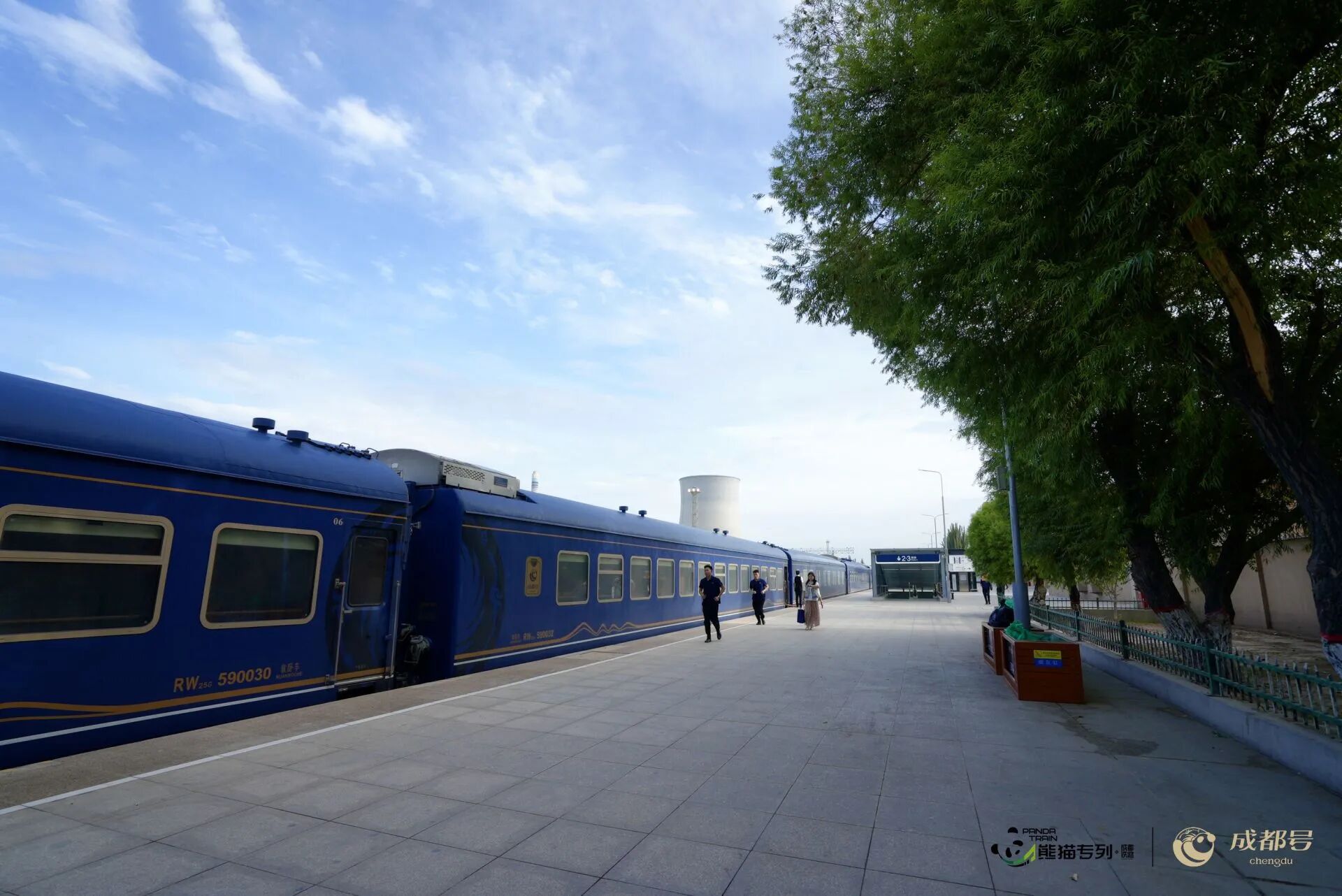
The Panda Express family now runs three luxury trains, and they are unusually easy to compare because almost everything except the price is held constant. All three are eighteen carriages. All three board in Chengdu. All three run a sixteen-day circuit through north and south Xinjiang. What separates them is how many people are on board and how much room each one gets: 108 guests on the Chengdu, 92 on the Jinxiu Tianfu, and 66 on the new Jinxiu Dongfang, at RMB 66,999, RMB 79,880 and RMB 138,888 respectively. That is the whole decision, and it is a cleaner one than most people expect.
Verdict first
Choose the Chengdu if the destination is the point and the train is the means. It costs about RMB 4,200 a day, it has been running since 2025, and it carries the most people. Choose the Jinxiu Tianfu if you want a genuine design-led flagship without doubling the budget; at RMB 79,880 it is the middle of the market and the one we recommend most often. Choose the Jinxiu Dongfang if the number of people on board is the thing that decides whether you enjoy a trip, and if the roughly RMB 8,700 a day is not a constraint. It is also the only one of the three with no operating history, which is the honest caveat.
What you should not do is pick on scenery. Kashgar, the Duku Highway, Kanas and the Pamir plateau appear on all three itineraries, and the differences in routing are smaller than the marketing suggests.
The spec sheet
| Chengdu 成都号 | Jinxiu Tianfu 锦绣天府号 | Jinxiu Dongfang 锦绣东方号 | |
|---|---|---|---|
| First season | 2025 | May 2026 | 2027 (not yet run) |
| Cars | 18 | 18 | 18 |
| Cabins | 54 | 46 | 33 |
| Guests | 108 standard | 92 | 66 |
| Top cabin size | 10 m2 | 13 m2 | approx. 15 m2 |
| Restaurant cars | One | One | Two |
| Design theme | Panda, Sichuan | Shu brocade, Song dynasty | Han and Tang dynasty |
| Journey | 16 days | 16 days | 16 days |
| 2027 from | RMB 66,999 | RMB 79,880 | RMB 138,888 |
| Per day from | RMB 4,187 | RMB 4,993 | RMB 8,681 |
| 2027 departures | 7 | 8 | 8 |
Chengdu: the workhorse
The Chengdu is where the family’s premium tier started, and it still does most of the volume. Fifty-four en-suite cabins across eighteen cars, 108 guests at standard configuration, and two grades: Youran Ju (悠然居) at 8 m2 and Shiyi Ju (诗意居) at 10 m2. It is the least expensive of the three by a comfortable margin and the least expensive of the two grades is genuinely small, so if you book it, spend the extra RMB 4,000 on the 10 m2 cabin.
The honest case against it is the crowd. At 108 guests you will share the restaurant car with more than a hundred people, the excursion coaches are full-size, and the observation car at a scenic stop is a negotiation. If you are travelling to see Xinjiang and you sleep well anywhere, none of that will bother you. If you are travelling for the train itself, it might.
Jinxiu Tianfu: the flagship
Jinxiu Tianfu launched in May 2026 as the family’s design statement, and it is the train we suggest most often. Forty-six cabins, 92 guests, and a Shu brocade and Song dynasty interior programme that is genuinely considered rather than themed wallpaper. JinWo (锦卧) is 10 m2, JinTa (锦榻) is 13 m2, and the spread between them is close to RMB 29,000, so cabin choice matters more here than anywhere else in the family.
It also has the most developed service offering of the three, with dual guides, a dedicated butler, an onboard medic who keeps health files for senior guests, and heritage workshops that travel with the train. At RMB 79,880 for a sixteen-day journey it sits at roughly RMB 5,000 a day, about twenty per cent above the Chengdu for meaningfully more room and a great deal more attention.
Jinxiu Dongfang: the purist
Jinxiu Dongfang is the argument taken to its conclusion. Eleven sleeping cars holding three cabins each make 33 cabins and 66 guests, in roughly 15 m2, with two restaurant cars rather than one. The design language moves from Song to Han and Tang. The staff-to-guest ratio is published at 1:2 and a staff photographer travels on every departure. Ground transport is described as one vehicle per cabin rather than a coach per forty.
The price is RMB 138,888, which is RMB 8,681 a day and roughly double Jinxiu Tianfu for the same sixteen days and the same scenery. Nobody should pretend that is a small difference. You are buying empty space: a wider corridor, a shorter queue, a quieter observation car, and a ground operation that never asks you to wait for forty other people. The counter-argument is that it has not carried a single paying guest yet, the published interiors are renderings rather than photographs, and even the car body platform is unconfirmed. We keep it outside our fleet ranking until that changes.
So which one?
Take the Chengdu if
You are here for Xinjiang, not for the train. You want the lowest realistic entry price, you are comfortable in a group, and you would rather spend the difference on a Chengdu pre-extension or a longer stay afterwards.
Take the Jinxiu Tianfu if
You want a flagship without the flagship premium. The design is the best realised of the three, the service is the most developed, and at RMB 5,000 a day it is the point where the value curve flattens.
Take the Jinxiu Dongfang if
The number of fellow passengers decides whether you enjoy a journey. You want the largest standard cabin in the family, two restaurants to choose between, and you are willing to be among the first guests on a train.
A useful way to pressure-test the decision: ask how many hours a day you expect to spend inside the train rather than outside it. On a sixteen-day Xinjiang circuit the answer is usually eight to ten, because evenings and overnights are on board. If that sounds like a lot of time in a 10 m2 room, the upgrade pays for itself. If it sounds like a place to sleep, it does not.
What all three share
- Boarding in Chengdu, with the same broad north and south Xinjiang circuit: Kanas, Sayram Lake, the Duku Highway, Kuqa, Kashgar and the Pamir plateau.
- All-inclusive fares covering the cabin, all onboard meals, the full day-tour programme with entrance tickets, ground transport, and the guide and butler team. Flights, visas and insurance are never included.
- No public ticket channel. Cabins are allocated through authorised agents, which is why the same sailing can be quoted differently by different sellers and why the inclusion list should be confirmed in writing before a deposit.
- Travel by night, explore by day, returning to the same cabin each evening. Average daily coach time is kept under four hours.
- Senior-guest provisions and English-speaking guides as standard, though the medical and language provision on the newest train should be confirmed for your specific departure.
Who actually runs them
All three are China Railway Chengdu Group products. Panda Roam (攀达漫迹) is the brand that handles promotion and distribution for the family; it is not the carrier, and we do not list it as the operator. This matters more than it sounds, because it tells you who is accountable if something goes wrong: the railway and its state tourism partner, not the marketing brand whose logo is on the brochure.
For the full 2027 dates and fares on all three, see the 2027 departure calendar. To put them side by side against the rest of the fleet, use the comparison tool. And if you tell us your dates, we will price all three properly against each other rather than leaving you to reconcile three brochures, which you can do from the contact page.